
____
The power and mysticism associated with sound is discussed by Ong in Orality and Literacy (1982). He suggests that ‘oral peoples’ ‘universally’ (Ong also works within the framework of broad generalizations: he too discusses oral communities from Ancient Greece to more contemporary African communities) consider sound to be magical, and thus powerful: “Sound cannot be sounding without the use of power. [...] In this sense, all sound, and especially oral utterance, which comes from inside living organisms, is dynamic.” (Ong, 32)
Ong examines the thought processes of the oral culture and dismisses the ability or practicality of forming thoughts as one would in a print culture: In an oral culture, to think through something in non-formulaic, non-patterned, non-mneumonic terms, even if it were possible, would be a waste of time, for such thought, once worked through, could never be recovered with any effectiveness, as it could be with the aid of writing. It would not be abiding knowledge but simply passing thought, however complex (3) In fact, Ong has an entire section devoted to the characteristics of orally based thought, citing non-expression, organization and redundancy within texts thought to be transcribed from oral cultures. (38) He also approaches poetry within oral cultures, claiming that the formulaic poetic techniques in the ancient world are evidence of a kind of written thought pattern that marks not only poetry “but more or less all thought and expression in primary oral culture.” (26)
McLuhan’s analysis of oral cultures as simultaneous and balanced is the backbone of his optimistic predictions about the electric age: that with the departure from a strictly print-based or eye-based culture, the possibility for a “seamless web of tribal kinship” exists. (McLuhan and Zingrone 239)
This is naturally related to his medium is the message theory, and relates to Ong’s ideas about technology or communication technologies changing the way we think and the way our senses react. McLuhan and the concrete poets shared this techno-materialist approach to sensory perception. Both recognized the body’s relationship with language and print, and specifically, the binding and linear nature of a society dependant on narratives and meanings put forth by a monopolized medium, its effects on our senses and our lives largely ignored. McLuhan’s preoccupation with the medium and our sensory relationship to media (meaning technology: print, type and ink as well as things like TV and radio) as a cultural concern is reflected in the artistic practice of the concrete poets.
Ong examines the thought processes of the oral culture and dismisses the ability or practicality of forming thoughts as one would in a print culture: In an oral culture, to think through something in non-formulaic, non-patterned, non-mneumonic terms, even if it were possible, would be a waste of time, for such thought, once worked through, could never be recovered with any effectiveness, as it could be with the aid of writing. It would not be abiding knowledge but simply passing thought, however complex (3) In fact, Ong has an entire section devoted to the characteristics of orally based thought, citing non-expression, organization and redundancy within texts thought to be transcribed from oral cultures. (38) He also approaches poetry within oral cultures, claiming that the formulaic poetic techniques in the ancient world are evidence of a kind of written thought pattern that marks not only poetry “but more or less all thought and expression in primary oral culture.” (26)
McLuhan’s analysis of oral cultures as simultaneous and balanced is the backbone of his optimistic predictions about the electric age: that with the departure from a strictly print-based or eye-based culture, the possibility for a “seamless web of tribal kinship” exists. (McLuhan and Zingrone 239)
This is naturally related to his medium is the message theory, and relates to Ong’s ideas about technology or communication technologies changing the way we think and the way our senses react. McLuhan and the concrete poets shared this techno-materialist approach to sensory perception. Both recognized the body’s relationship with language and print, and specifically, the binding and linear nature of a society dependant on narratives and meanings put forth by a monopolized medium, its effects on our senses and our lives largely ignored. McLuhan’s preoccupation with the medium and our sensory relationship to media (meaning technology: print, type and ink as well as things like TV and radio) as a cultural concern is reflected in the artistic practice of the concrete poets.

____
Steve McCaffery demonstrates McLuhan’s notion that technology acts as an extension of the senses. The tape recorder, as McCaffery notes, allowed for a sensory extension hitherto experienced in sound poetry in its historical manifestations – during the rise of what he calls the third phase of sound poetry (1950s onward), when sound poetry was not bound to the word or meaning. It is at this time, conceivably, that sound poetry joins what is known as concrete poetry and gives rise to the sensory perceptions and ambiguities with which McLuhan was wrestling in his exploration of oral and print-based cultures.
McCaffery outlines the history of sound poetry itself: while concrete poetry, he explains, emerged more towards the 1960’s, sound poetry as it has been explored by international artists and writers has been the focus of poetic and artistic experimentation for some time. The third phase, as McCaffery notes, was heralded by the tape recorder and offered the possibility of executing experiments in language and sound that were hitherto impossible. While it could be argued that the tape recorder represented a detachment of the senses, I am building on McCaffery’s contention and suggesting that it in fact extended them in offering the opportunity for additional experimentation and building on the relationship between senses and technology.
McCaffery outlines the history of sound poetry itself: while concrete poetry, he explains, emerged more towards the 1960’s, sound poetry as it has been explored by international artists and writers has been the focus of poetic and artistic experimentation for some time. The third phase, as McCaffery notes, was heralded by the tape recorder and offered the possibility of executing experiments in language and sound that were hitherto impossible. While it could be argued that the tape recorder represented a detachment of the senses, I am building on McCaffery’s contention and suggesting that it in fact extended them in offering the opportunity for additional experimentation and building on the relationship between senses and technology.
____
Christian Bök responds to the question posed by OEI (2001) on the future of poetry after language poetry. He expresses the anxiety that the electronic age brings to poetry, as well as evoking McLuhan’s expectation of a blurring of boundaries within not only senses but creative expression: artistic and romantic strongholds such as ‘inspiration’ have been affected by the electronic medium and environment:
"Poets may have to become advanced typesetters and computer programmers - technicians, polyglot in a variety of machinic [sic] dialects. Poets may have to learn the exotic jargon of scientific discourses just to make use of a socially relevant lexicon, and now that cybernetics has effectively discredited the romantic paradigm of inspiration, poets may have to take refuge in a new set of aesthetic metaphors for the unconscious, adapting themselves to the mechanical procedures of automatic writing, aleatoric [sic] writing, and mannerist writing - poetry that no longer expresses our attitudes so much as it processes our databanks." (Bök, 2001)
This posits the question as to whether the electronic age, with its cross-sensory perceptions has allowed for the kind of unity that McLuhan anticipated. In Counterblast (1969), McLuhan commented that, “By surpassing writing, we have regained our sensorial WHOLENESS, not on a national or cultural plane, but on a cosmic plane. We have evoked a super-civilized sub-primitive man.” I would argue that the concrete poetry between the 60’s and 80’s offered something close to this goal of sensorial wholeness of the sub-primitive man, but that with the Internet age, for poetry at least, there exists an anxiety - which perhaps is simply characteristic of its newness – with regards to the sensorial simultaneity.
"Poets may have to become advanced typesetters and computer programmers - technicians, polyglot in a variety of machinic [sic] dialects. Poets may have to learn the exotic jargon of scientific discourses just to make use of a socially relevant lexicon, and now that cybernetics has effectively discredited the romantic paradigm of inspiration, poets may have to take refuge in a new set of aesthetic metaphors for the unconscious, adapting themselves to the mechanical procedures of automatic writing, aleatoric [sic] writing, and mannerist writing - poetry that no longer expresses our attitudes so much as it processes our databanks." (Bök, 2001)
This posits the question as to whether the electronic age, with its cross-sensory perceptions has allowed for the kind of unity that McLuhan anticipated. In Counterblast (1969), McLuhan commented that, “By surpassing writing, we have regained our sensorial WHOLENESS, not on a national or cultural plane, but on a cosmic plane. We have evoked a super-civilized sub-primitive man.” I would argue that the concrete poetry between the 60’s and 80’s offered something close to this goal of sensorial wholeness of the sub-primitive man, but that with the Internet age, for poetry at least, there exists an anxiety - which perhaps is simply characteristic of its newness – with regards to the sensorial simultaneity.
____
Christopher Horrocks states that McLuhan reaches beyond posthumanism and simultationism because his claims of sensory harmony and immediacy are linked directly to ‘a myth of return’ via technology. (Horrocks, 40) McLuhan claimed that with the electronic age "we are back in acoustic space. We have begun again to structure the primordial feeling, the tribal emotions (from which a few centuries of literacy divorced us) of a culture that preceded the invention of writing and printing." (McLuhan and Fiore 1967, 63)
The concrete poets writing (and performing, recording, speaking) at the time of McLuhan’s writings were exploring a tribalization that exploded the sensory dependence of print and meaning. While poets online are struggling with how to continue with a creative and sensory revolution, they are admittedly dealing with issues of non-linear temporality and spatiality, despite the medium’s connection and historical relationship (via language and readership) with print.
But what is the ‘acoustic space’ and how does it relate to the concrete poets – including in their media sound, visual, language and otherwise? The notion of space, be it acoustic, typographic or virtual, have implications that are deeply tied to McLuhan’s sensory perceptions and observations on the oral and literary experience. Visual experimental poetry depended on the very ink and paper as the meanings rather than as a conduit.
In exploring concrete poetry and McLuhan’s notion of both the multi-sensory electric culture and the medium as the message, one might ask, what of the materiality of language? Or put another way, what of the visual nature of language?
The concrete poets writing (and performing, recording, speaking) at the time of McLuhan’s writings were exploring a tribalization that exploded the sensory dependence of print and meaning. While poets online are struggling with how to continue with a creative and sensory revolution, they are admittedly dealing with issues of non-linear temporality and spatiality, despite the medium’s connection and historical relationship (via language and readership) with print.
But what is the ‘acoustic space’ and how does it relate to the concrete poets – including in their media sound, visual, language and otherwise? The notion of space, be it acoustic, typographic or virtual, have implications that are deeply tied to McLuhan’s sensory perceptions and observations on the oral and literary experience. Visual experimental poetry depended on the very ink and paper as the meanings rather than as a conduit.
In exploring concrete poetry and McLuhan’s notion of both the multi-sensory electric culture and the medium as the message, one might ask, what of the materiality of language? Or put another way, what of the visual nature of language?
____
In his atypically structured essay “Artiface and Absorption”, poet Charles Bernstein poses the question of whether the structure or content of the poem ‘mean’ anything, whether they are mutually exclusive and how meaning is ‘absorbed’ by the viewer/reader. Poems where the structure requires further reading (beyond the structure) to find the meaning, he calls Artiface, opposed to Realism, which involves an unmediated and direct meaning.
Just as McLuhan demands that the content is not priority and that the medium must be considered, Bernstein states that the structure must be considered, lest all that remains is content and content does not automatically equal meaning. He states that if the structure or materiality is foregrounded, there is a tendency to assume that there is no meaning at all, as though the poem is an experiment in the mechanics of the language. This is interesting in light of the concrete poets for whom the mechanics of the language were often (or often appeared to be) the priority.
In describing the submeanings of a poem structured in what Bernstein calls Artiface, McCaffery uses economic terms first outlined by Georges Bataille. Bataille took Marx’s notion of a restricted economy based in market value, and applied it to aesthetics, ritual and transgression. General economy, as opposed to the restricted economy according to Bataille, is excess value, or runoff. In McCaffery’s paper on writing as a general economy, he takes this notion of excess and applies it to structurally-based poetry. In this model, in a restrictive economy, the content is privileged at the expense of the structure (wherein the structure of the language/poem is ignored); in the general economy, the structure is privileged at the expense of the content: the medium is the message.
Bernstein makes note of a young theorist of the 60s, Veronica Forrest-Thompson, who developed the notion of the total image complex. For Forrest-Thompson, the image-complex is the node that encapsulates the rhythm, structure, sound, materiality and semiotics of a poem outside the critical reading. She felt that the viewer/reader should reserve judgment on the critical reading in order to experience the image-complex. Again, this is a McLuhanesque notion; that the entire –rounded, rather than eye-dominant -sensory experience be observed outside of the content, or the message.
Just as McLuhan demands that the content is not priority and that the medium must be considered, Bernstein states that the structure must be considered, lest all that remains is content and content does not automatically equal meaning. He states that if the structure or materiality is foregrounded, there is a tendency to assume that there is no meaning at all, as though the poem is an experiment in the mechanics of the language. This is interesting in light of the concrete poets for whom the mechanics of the language were often (or often appeared to be) the priority.
In describing the submeanings of a poem structured in what Bernstein calls Artiface, McCaffery uses economic terms first outlined by Georges Bataille. Bataille took Marx’s notion of a restricted economy based in market value, and applied it to aesthetics, ritual and transgression. General economy, as opposed to the restricted economy according to Bataille, is excess value, or runoff. In McCaffery’s paper on writing as a general economy, he takes this notion of excess and applies it to structurally-based poetry. In this model, in a restrictive economy, the content is privileged at the expense of the structure (wherein the structure of the language/poem is ignored); in the general economy, the structure is privileged at the expense of the content: the medium is the message.
Bernstein makes note of a young theorist of the 60s, Veronica Forrest-Thompson, who developed the notion of the total image complex. For Forrest-Thompson, the image-complex is the node that encapsulates the rhythm, structure, sound, materiality and semiotics of a poem outside the critical reading. She felt that the viewer/reader should reserve judgment on the critical reading in order to experience the image-complex. Again, this is a McLuhanesque notion; that the entire –rounded, rather than eye-dominant -sensory experience be observed outside of the content, or the message.
____
On typographic space, Ong dedicates a section in Orality and Literacy. He discusses the relationship between words, or more specifically type and the white space of paper – what artists call ‘negative space,’ meaning the space or shapes defined by what is leftover after a ‘real’ medium has carved out its shape. Ong makes reference to poetry by e.e.cummings:
"White space is so integral to cumming’s poem [Poem No. 276 (1968)] that it is utterly impossible to read the poem aloud. The sounds cued in by the letters have to be present in the imagination but their presence is not simply auditory: it interacts with the visually and kinesthetically perceived space around them." (Ong, 129)
Ong continues on the topic of concrete poetry claiming that it "climaxes in a certain way the interaction of sounded words and typographic space.” (Ong, 129) demonstrating an inter-sensory play that does not depend on or privilege a particular sense, but ‘via technology’ extends the senses.
"White space is so integral to cumming’s poem [Poem No. 276 (1968)] that it is utterly impossible to read the poem aloud. The sounds cued in by the letters have to be present in the imagination but their presence is not simply auditory: it interacts with the visually and kinesthetically perceived space around them." (Ong, 129)
Ong continues on the topic of concrete poetry claiming that it "climaxes in a certain way the interaction of sounded words and typographic space.” (Ong, 129) demonstrating an inter-sensory play that does not depend on or privilege a particular sense, but ‘via technology’ extends the senses.
____
McCaffery notes that experimentation with sound and language occurred long before the ‘third phase’ of the concrete poets in sound and language experimentations explored by the Italian and Russian Futurists (Marietti, Khlebnikov and Kruchenykh), stating that the “first decisive break with language’s symbolic relationship with an object” came with the Russian Futurist manifesto Words As Such of 1910. Also experimenting with sound and language were Lewis Caroll with Jaberwocky (1912) and Kruchenykh with the chant-like zaum poems (ca. 1910). While these earlier poets dealt with language and sound, the approach to tribalism, simultaneous sensory perception and spontaneity certainly appeared to have arrived with the concrete poets of the 50’s and 60’s.
For McLuhan, sound and language could both be afforded a simultaneous experience in non-linear space, unbound to meaning and narrative, unbound to time and a dominant sense. He wrote to his mentor Wyndham Lewis in 1954 what sounds as though it could be a sound poet’s manifesto,
"Acoustic space is spherical. It is without bounds or vanishing points. It is structured by pitch separation and kinesthesia. It is not a container. It is not hollowed out. It is the space in which men live beore the invention of writing – that translation of the acoustic into the visual. With writing men began to trust their eyes and to structure space visually. Pre-literate man does not trust his eyes very much. The magic is in sound for him, with its powers to evoke the absent." (Theall, 145)
Similarly, as Cavell states with regard to the ideogram,
"Here, alphabetic letters are turned into ideogrammatical constructions that constitute a rejection of the alphabet and a recovery of the simultaneity and sensory interrelatedness of speech – an interrelatedness that includes the interrelations of the visual and the auditory as spatial constructions." (Cavell, 145)
For McLuhan, sound and language could both be afforded a simultaneous experience in non-linear space, unbound to meaning and narrative, unbound to time and a dominant sense. He wrote to his mentor Wyndham Lewis in 1954 what sounds as though it could be a sound poet’s manifesto,
"Acoustic space is spherical. It is without bounds or vanishing points. It is structured by pitch separation and kinesthesia. It is not a container. It is not hollowed out. It is the space in which men live beore the invention of writing – that translation of the acoustic into the visual. With writing men began to trust their eyes and to structure space visually. Pre-literate man does not trust his eyes very much. The magic is in sound for him, with its powers to evoke the absent." (Theall, 145)
Similarly, as Cavell states with regard to the ideogram,
"Here, alphabetic letters are turned into ideogrammatical constructions that constitute a rejection of the alphabet and a recovery of the simultaneity and sensory interrelatedness of speech – an interrelatedness that includes the interrelations of the visual and the auditory as spatial constructions." (Cavell, 145)
____
Theall notes of McLuhan’s relationship with acoustic space throughout the years with explorations into poetry, art and culture:
"The initial phrase “acoustic space, “ probed and played with through three decades, becomes itself an artifact (or “medium”), suggestively exploring the metamorphoses achieved through the transformations affected by electric technologies of production, reproduction, and dissemination on the pre-electric technologies of print and visual prints, writing, and visual art." (Theall, 146)
"The initial phrase “acoustic space, “ probed and played with through three decades, becomes itself an artifact (or “medium”), suggestively exploring the metamorphoses achieved through the transformations affected by electric technologies of production, reproduction, and dissemination on the pre-electric technologies of print and visual prints, writing, and visual art." (Theall, 146)
____
McLuhan’s texts and treatments, as well as his forays into non-linear visual speech and space demonstrate his close link to the concrete poets. What his tetrads in particular in their visual formation recall, as does the work of the concrete poets, is a formulaic approach to language, sound and the visual that in its very process are a technique similar to that used in oral cultures.
____
As Ong acknowledges, “concrete poetry is [...] often merely gimmicky – a fact that makes it all the more necessary to explain the drive to produce it.” (Ong, 129)
McLuhan, while he appeared to have an eclectic approach to scholarship and never claimed to be a theorist, recognized the importance of, or our inability to extricate ourselves from meaning.
And Steve McCaffery says while exploring the relationship between ink and words, language and meaning, "as its material support, sound and ink are separable from the signifying process, but at the same time the process is unsupportable without it. In light of this one could consider language’s materiality as meaning’s heterological object, as that area inevitably involved within the semantic apparatus that meaning casts out and rejects." (McCaffrey, 203)
McLuhan, while he appeared to have an eclectic approach to scholarship and never claimed to be a theorist, recognized the importance of, or our inability to extricate ourselves from meaning.
And Steve McCaffery says while exploring the relationship between ink and words, language and meaning, "as its material support, sound and ink are separable from the signifying process, but at the same time the process is unsupportable without it. In light of this one could consider language’s materiality as meaning’s heterological object, as that area inevitably involved within the semantic apparatus that meaning casts out and rejects." (McCaffrey, 203)
____
For McLuhan, technological change offers a revolution of the senses. Concrete poetry of the 60’s to 80’s exemplified an exploration in the ink, the sound and the visual – essentially McLuhan’s Medium as the Message. But as even McLuhan stated on this front, “By stressing that the medium is the message rather than the content, I’m not suggesting that the content plays no role – merely that it plays a distinctly subordinate role.” (McLuhan and Zingrone 1995, 247) The sensory overload that McLuhan would have witnessed at the explosion of the Internet doesn’t seem to provide the kinship, the complete balance and outering that McLuhan had speculated about; it instead harbors a more self-conscious anxiety that McLuhan may say is a good thing. Nevertheless, for a time during the peak of the concrete poets, a recognition of a desire for balanced sensory experience and perception – a self-aware return to the tribal ear culture - was executed alongside McLuhan’s work.
____
Bernstein, Charles. “A Poetics” from A Poetics. 1992, pp. 9 – 89
Bök, Christian., OEI 7-8 2001: AFTER LANGUAGE POETRY, 2001, p. 2
Cavell, Richard. McLuhan in Space: A Cultural Geography, (Toronto, Ontario: University of Toronto Press Inc, 2002), p. 145
Horrocks, Christopher., Baurillard and the New Millenium, (Duxford, Cambridge, U.K, 1999), p. 40
McCaffery, Steve. “Sound Poetry – A Survey”. From Sound Poetry: A Catalogue, edited by Steve McCaffery and bpNichol, Underwich Editions, Toronto, 1978, http://www.ubu.com/papers/mccaffery.html
McCaffery, Steve. “Writing as a General Economy” in Artiface and Indeterminacy: An Anthology of New Poetics, University of Alabama Press, 1998, pp. 201 – 221, 203
McLuhan, Marshall and Fiore, Quentin. The Medium is the Massage: An Inventory of Effects. (NY, London, Toronto: Bantam, 1967). p. 63
McLuhan, Eric and Frank Zingrone. Essential McLuhan. (Toronto: House of Anasi Press), 1995, p. 97, 101, 117, 247.
Ong, Walter J. Orality and Literacy: The Technologizing of the World. (London: Methuen & Co. Ltd., 1982), p. 32, 3, 38, 26, 129
Theall, Donald. The Virtual McLuhan. Montreal, London: McGill-Queen’s University Press, 2001. p. 145, 146
Bök, Christian., OEI 7-8 2001: AFTER LANGUAGE POETRY, 2001, p. 2
Cavell, Richard. McLuhan in Space: A Cultural Geography, (Toronto, Ontario: University of Toronto Press Inc, 2002), p. 145
Horrocks, Christopher., Baurillard and the New Millenium, (Duxford, Cambridge, U.K, 1999), p. 40
McCaffery, Steve. “Sound Poetry – A Survey”. From Sound Poetry: A Catalogue, edited by Steve McCaffery and bpNichol, Underwich Editions, Toronto, 1978, http://www.ubu.com/papers/mccaffery.html
McCaffery, Steve. “Writing as a General Economy” in Artiface and Indeterminacy: An Anthology of New Poetics, University of Alabama Press, 1998, pp. 201 – 221, 203
McLuhan, Marshall and Fiore, Quentin. The Medium is the Massage: An Inventory of Effects. (NY, London, Toronto: Bantam, 1967). p. 63
McLuhan, Eric and Frank Zingrone. Essential McLuhan. (Toronto: House of Anasi Press), 1995, p. 97, 101, 117, 247.
Ong, Walter J. Orality and Literacy: The Technologizing of the World. (London: Methuen & Co. Ltd., 1982), p. 32, 3, 38, 26, 129
Theall, Donald. The Virtual McLuhan. Montreal, London: McGill-Queen’s University Press, 2001. p. 145, 146
____
The following posts have been extracted from Katherine Hayles's 2006 book chapter The Time of Digital Poetry: From Object to Event.
- APA: Hayles, N. K. (2006). The time of digital poetry: from object to event, in New Media Poetics: Contexts, Technotexts, and Theories, Morris, A and Swiss, T., (eds), MIT Press,143-164.
- Chicago: Katherine N. Hayles, "The time of digital poetry: from object to event." in New Media Poetics: Contexts, Technotexts, and Theories Morris, A and Swiss, T., (eds), MIT Press (2006): 143-164.
____
I propose thinking about the digital poem as a machine to organize time. Inevitably, space is also involved in this production, but by keeping the focus on time, I hope to bring out characteristics of digital poetry that, while acknowledging continuities with print poetry, also suggest new directions theory can take in accounting for the operation of these poem-machines.
____
What does it mean to say that the poem is a machine that organizes time? The time of a poem can be considered to consist of the time of writing, the time of coding, the time of production/performance, and the time of reading. While both print and electronic poetry evolve within this general temporal flow, they organize it differently.
____
Loss Pequeño Glazier sees print and electronic text on a continuum, arguing that “innovative literature” in both media “has explored the conditions that determine ... the procedures, processes, and crossed paths of meaning-making, meaning-making as constituting the ‘meaning’”. As Glazier points out, print writers have also explored the materiality of the medium, from the typewriter poems of Ian Hamilton Finlay to the mimeo movement and concrete poetry. The specificity of digital media, he implies, lies in its distinctive materiality: “materiality is key to understanding innovative practice.”
The materiality of digital text increases the writer’s sense that writing is not merely the fashioning of a verbal abstraction but a concrete act of making, a production that involves manual manipulation, proprioceptive projection, kinesthetic involvement, and other physical senses.
The materiality of digital text increases the writer’s sense that writing is not merely the fashioning of a verbal abstraction but a concrete act of making, a production that involves manual manipulation, proprioceptive projection, kinesthetic involvement, and other physical senses.
____
A digital text does not exist anywhere in the computer or in the networked system in the precise form it acquires when displayed on screen. As processes, digital texts exhibit sensitive dependence on temporal and spatial contexts, to say nothing of their absolute dependence on specific hardware and software configurations. Changes of some kind may happen every time the text is performed, from small differences in timing to major glitches when a suddenly obsolete program tries to run on a platform that has not maintained backward compatibility.
____
What are the consequences of admitting an idea of textuality that is dispersed rather than unitary, processual rather than object-like, flickering rather than durably inscribed, always differing from itself rather than repro-ducing itself as a stable entity?
An obvious result is the highlighting of the temporal dimension, inviting experiments that play with the flickering indeterminacies of digital texts. Moreover, with texts that allow some degree of interactivity, reading also becomes a performance in a more kinesthetically complex and vivid sense than is the case with reading print texts. The machine produces the text as an event; the reader interacts with that event in ways that significantly modify and even determine its progress; these readerly interventions feed back into the machine to change its behavior, which further inflects the course of the performance. Less an object than an event, the digital text emerges as a dance between artificial and human intelligences, machine and natural languages, as these evolve together through time.
An obvious result is the highlighting of the temporal dimension, inviting experiments that play with the flickering indeterminacies of digital texts. Moreover, with texts that allow some degree of interactivity, reading also becomes a performance in a more kinesthetically complex and vivid sense than is the case with reading print texts. The machine produces the text as an event; the reader interacts with that event in ways that significantly modify and even determine its progress; these readerly interventions feed back into the machine to change its behavior, which further inflects the course of the performance. Less an object than an event, the digital text emerges as a dance between artificial and human intelligences, machine and natural languages, as these evolve together through time.
____
Traditionally, the translatability of texts has been seen to depend on a logos that transcended the medium in which it was instantiated. When in the Biblical account Adam names the animals, this act of naming is presented not as a willful act of creating arbitrary signs but as a linguistic enactment of the names given by God, guarantor that the link between word and referent is appropriate and correct. Standing apposite to these assumptions is the Tower of Babel, where the nontranslatability of different languages into one another is the divine punishment for the hubris of mortals who, thinking they can come close to heaven, may also harbor designs to infringe upon the divine copyright to know and assign true names.
____
With digital media, by contrast, translatability across media is guaranteed by the binary code to which all these texts are ultimately reduced, a process Lev Manovich analyzes in his discussion of transcoding (2001, 45–48). Rather than depending on the transcendental signifier, electronic texts tremble at the edge of what Cayley calls the “abyss” of binary code, a form of symbolic language difficult for humans to understand in its raw form; rather than pointing up toward the purity of the Word, digital devices plunge down into a froth of code that becomes progressively less intelligible to humans as it moves closer to the point where it is instantiated in the materiality of the machine as on-off voltages. To mark this difference between the transcendental assumptions undergirding translation and the machine processes of code, Cayley suggests that “transliteration” would be a better choice to describe the re-encoding of print or manuscript documents into electronic texts.
I have suggested that fully exploring the implications of media specificity will require new conceptualizations of materiality (Hayles 2002, 19–34). Rather than think about the materiality of texts as a fixed set of physical properties characteristic of an object, we might consider it as emerging from the ways a text mobilizes the physical characteristics of the technology in which it is instantiated to create meaning. Materiality in this view is a different concept than physicality. Materiality implies a characterization and selection of physical properties that could be listed as comprising an object. How the poem-event goes in search of meaning determines which aspects of the technology are foregrounded, so materiality emerges as a dance between the medium’s physical characteristics and the work’s signifying strategies. Contingent, provisional, and debatable, materiality itself thus comes to be seen as more an event than a preexisting object, a nexus at which culture, language, technology, and meaning interpenetrate.
I have suggested that fully exploring the implications of media specificity will require new conceptualizations of materiality (Hayles 2002, 19–34). Rather than think about the materiality of texts as a fixed set of physical properties characteristic of an object, we might consider it as emerging from the ways a text mobilizes the physical characteristics of the technology in which it is instantiated to create meaning. Materiality in this view is a different concept than physicality. Materiality implies a characterization and selection of physical properties that could be listed as comprising an object. How the poem-event goes in search of meaning determines which aspects of the technology are foregrounded, so materiality emerges as a dance between the medium’s physical characteristics and the work’s signifying strategies. Contingent, provisional, and debatable, materiality itself thus comes to be seen as more an event than a preexisting object, a nexus at which culture, language, technology, and meaning interpenetrate.
____
Descartes notwithstanding, the cogito res, taken here to mean the machine that thinks as well as the human that thinks, can never be stabilized so as to be self evidently present to itself as itself. These poem-events, similar to the readers they construct and require, are rivers that flow, processes that evolve, materialities that emerge contingently, flickering in the constantly changing plays of meanings.
____
Glazier, Loss Pequeño. 2002. Digital Poetics: The Making of E-Poetries. Tuscaloosa, AL: University of Alabama Press.
Hayles, N. Katherine. 2002. Writing Machines. Cambridge, MA: MIT Press. p: 19 - 34.
Manovich, Lev. 2001. The Language of New Media. Cambridge, MA: MIT Press. p: 45 - 48.
Hayles, N. Katherine. 2002. Writing Machines. Cambridge, MA: MIT Press. p: 19 - 34.
Manovich, Lev. 2001. The Language of New Media. Cambridge, MA: MIT Press. p: 45 - 48.
____
The following posts have been extracted from John Cayley and Dmitri Lemmerman's 2006 article Lens: The Practice and Poetics of Writing in Immersive VR: A Case Study with Maquette.
- APA: Cayley, J., Lemmerman, D., (2006). Lens: The Practice and Poetics of Writing in Immersive VR (A Case Study with Maquette). LEA, 14(05-06).
- Chicago: John Cayley, John, and Dmitri Lemmerman., "Lens: The Practice and Poetics of Writing in Immersive VR (A Case Study with Maquette)." LEA 14, no. 05-06 (2006).
____
What is, what will be, the phenomenology and aesthetics of text in 3-D space?
‘Is there a phenomenology of text in space?’ I would answer that there is, but that it is, as it were, constrained. Specifically, in the case of text as writing, it is constrained to surfaces. Text, in this form — as perceptual material object, as a composition of printed or inscribed letters — is two-dimensional. It has no appreciable thickness, and rests, third-dimensionless, on a surface whose thickness is, itself, largely non-signifying. It is often desirable that the actual surface of writing be as thin as possible. Of course there are exceptional cases, where we become aware, for example, of a force producing real depth in a surface that bears a carved or incised piece of lettering, or when the mark-making ‘ink’ is ‘thick,’ literally, as well as figuratively.
‘Is there a phenomenology of text in space?’ I would answer that there is, but that it is, as it were, constrained. Specifically, in the case of text as writing, it is constrained to surfaces. Text, in this form — as perceptual material object, as a composition of printed or inscribed letters — is two-dimensional. It has no appreciable thickness, and rests, third-dimensionless, on a surface whose thickness is, itself, largely non-signifying. It is often desirable that the actual surface of writing be as thin as possible. Of course there are exceptional cases, where we become aware, for example, of a force producing real depth in a surface that bears a carved or incised piece of lettering, or when the mark-making ‘ink’ is ‘thick,’ literally, as well as figuratively.

____
There are also a wide variety of exceptional cases arising from practices of Concrete poetry and poetics, to which we will return. However, typically text is a matter for surfaces. In so far as it dwells in space, it dwells on surfaces. Usually this is an opaque and resistant surface, through which other physical objects, including ourselves, cannot pass; not, at least, without damaging or destroying the writing. Of course, surfaces that bear writing do themselves have locations in real space. They are, typically, portable and often gathered into piles or collections of paper leaves. In the West, traditionally, the codex book is where writing most often dwells.
In the World of Letters, writing in real space occurs on signs, on monumental inscriptions, and on objects that require labels, chiefly containers or vehicles. These are all special surfaces which are very much site and context specific, set up to function in an exact and particular manner — to inform, warn, attract custom and attention; to celebrate, memorialize, identify, and so on. Note that only rarely is the text displayed on surfaces in space anything other than functional; such text requires to be inscribed and read out of necessity rather than rhetorical desire.
In the World of Letters, writing in real space occurs on signs, on monumental inscriptions, and on objects that require labels, chiefly containers or vehicles. These are all special surfaces which are very much site and context specific, set up to function in an exact and particular manner — to inform, warn, attract custom and attention; to celebrate, memorialize, identify, and so on. Note that only rarely is the text displayed on surfaces in space anything other than functional; such text requires to be inscribed and read out of necessity rather than rhetorical desire.
____
Constraints on the spatial manifestation of written text has a further implication relating to the characteristics of writing as graphic form. Because writing is typically located either on portable surfaces or on surfaces that are intended to be read in very specific contexts and for very specific purposes, we have a very clear idea of its graphic constituents’ — that is, its letters’ — size. Letters must always be a good size for reading, big enough to allow us to distinguish the differences which constitute symbolic structure, small enough to copy-fit a significant gobbet of text in the available surface area. Letter forms are, in the Structuralist’s sense, arbitrary. To support the differences they establish, they must be relatively complex shapes, and yet they must become familiar, in the culture where they are current, especially to literate viewers, for whom their very differentiated complexities enable reading. Graphically, and in terms of phenomenology, this gives us — culturally, experientially — a vocabulary of graphic forms about whose size we have very specific ideas and expectations.
____
Screens are a particular case of writing surface and, manifestly, they are shifting our experience of written language, although more slowly than might have been expected. In the early days of personal and networked computing, screens carried text, but did so in a manner that ran counter to the highly developed aesthetics of print and literary culture. Moreover, this occurred at the same time that screens were establishing themselves, in the form of television, as the visual business end of receivers for broadcast representations of distant real-world spaces. To do so it employs conventional, illusionistic spatial representations, generated by and adapted from lens optics, photography and film. Today, when we use a computer screen, not only do we expect it to be capable of these visual representations, so familiar from film and television, we also demand a fair degree of spatial representation in our software tools, even when all we are doing is, for example, typing.
____
Even the flat (third-dimensionless) screen of the programmaton, because of its increasingly implicated relations with film and television, invites our engagement with the illusionistic, naturalistic representation of space, and this continues to have implications for any aestheticized presentation of text on the screen, on the making, that is, of screen-based literal art. To be more specific, it has implied another and, for some readers, a promisingly ‘new’ relationship with the phenomenology of text in space, all without directly addressing the issues and problems as such.
I would argue that the effect on literal art and poetics in new media — the effect of this failure to address directly the phenomenology of text and the ambiguities of the display media — has been to push literal art in the direction of a Concrete poetics. By Concrete, I mean a poetics in which written language — letters and words — take on characteristics of other kinds of objects in order to generate rhetorical and aesthetic affect and significance.
I would argue that the effect on literal art and poetics in new media — the effect of this failure to address directly the phenomenology of text and the ambiguities of the display media — has been to push literal art in the direction of a Concrete poetics. By Concrete, I mean a poetics in which written language — letters and words — take on characteristics of other kinds of objects in order to generate rhetorical and aesthetic affect and significance.
____
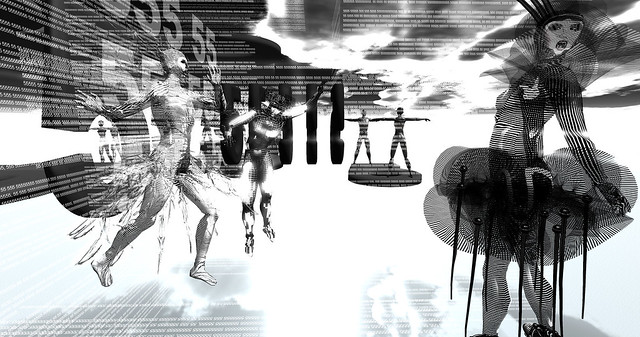
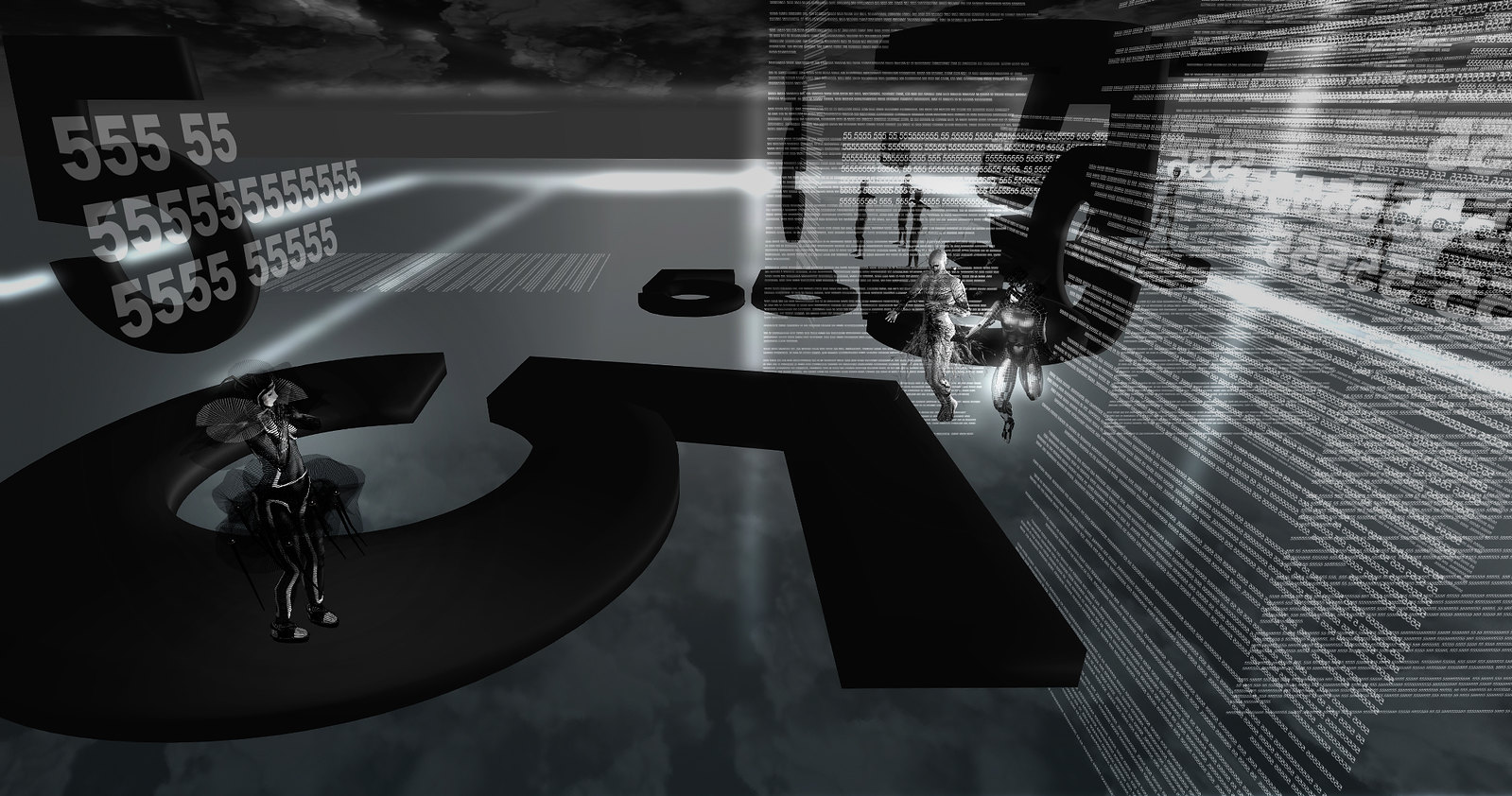
I wanted my letters in space always to face the primary tracked point of view. If the tracked reader is positioned at the edge of a plane of letters and she turns to face the plane edge-on, the letters turn to face her. Their images overlap, occlude one another — partially or wholly — and recede in view since the majority of them will be successively more or less distant. ‘Normally’ the surfaces of the larger closer letters would cover the more distant smaller letters. However, because of the ‘bug,’ smaller letter outlines are clearly discernible within but ‘over’ the forms of the nearer letters.
Given these circumstances, and because, I believe, all the letter forms are familiar — both visually and symbolically legible — and because we know what their relative scale ‘should be,’ this produces a striking and somewhat bizarre visual illusion.
We assume that even though the smaller letters are rendered ‘over’ the larger ones, they must be more distant. Thus, what we see is a very deep and narrow corridor formed from letter shapes, with the most distant smallest letters visible in completely edged outline, apparently farthest off, as if inscribed on a tall, thin distant end ‘wall’ of the corridor. Moreover, the reader is able to move ‘into’ the corridor formed by this plane of letter shapes.
This powerful perceptual experience is demonstrable and repeatable, despite its artificiality and strangeness. The question arises, why should this phenomenon be so immediate and effective? As we asked above, why doesn’t the linguistic materiality of the graphic forms and structures run counter to their visuality, counter to whatever illusion of space may or may not be generated? At this point I began to formulate a hypothesis: literal forms are highly effective for delineating space in immersive virtual environments.
I believe that there are a number of quite common sense related reasons for this. Letter forms are relatively complex and the differences instantiated in this complexity are necessarily and systematically significant. Letter forms are both complex and arbitrary but they are also familiar and rational seeming. They are instantly recognizable and encountered with remarkable, perhaps unique, frequency by any subject in a culture where the set of script forms in question is current, particularly, of course, by subjects who use these forms to read and write.
Moreover we have a very well entrenched set of expectations in relation to the relative size of these arbitrary graphic shapes. If we believe them to be on the same plane, we expect literal elements all to be of a similar or commensurate size (equal constituents of the same text) or, if they are of different sizes, we expect there to be a paratextual reason for this (because, for example, the letters are part of an emphasized word or a title). If we see words or letters which are larger than the letters surrounding them and there is no paratextual reason for this, we are likely to think that these letters are closer to us than any surrounding smaller letters.
Given these circumstances, and because, I believe, all the letter forms are familiar — both visually and symbolically legible — and because we know what their relative scale ‘should be,’ this produces a striking and somewhat bizarre visual illusion.
We assume that even though the smaller letters are rendered ‘over’ the larger ones, they must be more distant. Thus, what we see is a very deep and narrow corridor formed from letter shapes, with the most distant smallest letters visible in completely edged outline, apparently farthest off, as if inscribed on a tall, thin distant end ‘wall’ of the corridor. Moreover, the reader is able to move ‘into’ the corridor formed by this plane of letter shapes.
This powerful perceptual experience is demonstrable and repeatable, despite its artificiality and strangeness. The question arises, why should this phenomenon be so immediate and effective? As we asked above, why doesn’t the linguistic materiality of the graphic forms and structures run counter to their visuality, counter to whatever illusion of space may or may not be generated? At this point I began to formulate a hypothesis: literal forms are highly effective for delineating space in immersive virtual environments.
I believe that there are a number of quite common sense related reasons for this. Letter forms are relatively complex and the differences instantiated in this complexity are necessarily and systematically significant. Letter forms are both complex and arbitrary but they are also familiar and rational seeming. They are instantly recognizable and encountered with remarkable, perhaps unique, frequency by any subject in a culture where the set of script forms in question is current, particularly, of course, by subjects who use these forms to read and write.
Moreover we have a very well entrenched set of expectations in relation to the relative size of these arbitrary graphic shapes. If we believe them to be on the same plane, we expect literal elements all to be of a similar or commensurate size (equal constituents of the same text) or, if they are of different sizes, we expect there to be a paratextual reason for this (because, for example, the letters are part of an emphasized word or a title). If we see words or letters which are larger than the letters surrounding them and there is no paratextual reason for this, we are likely to think that these letters are closer to us than any surrounding smaller letters.
____
If these effects are conceded, it follows that literal materiality can have powerful influence on the shaping of immersive 3-D space and the structures within it. What I take to be happening is that the pre-existing, enculturated phenomenology of textuality, when disposed in this illusory space, struggles to maintain its real-world phenomenology, with and against the graphic world’s programmed structures. A relationship of mutual interference and influence develops in which the phenomenology of text shapes the reader’s experience of space while, at the same time, of course, spatiality works to alter our phenomenological experience of text in its new, artificial environment.
____
The following posts are quotes that have been harvested from Anna Katharina Schaffner's 2010 book chapter From Concrete to Digital: The Reconceptualization of Poetic Space.
- APA: Schaffner, A. K. (2010). From Concrete to Digital: The Reconceptualization of Poetic Space, in Beyond the Screen: Transformations of Literary Structures, Interfaces and Genres, Schaefer, J., Gendolla, P. (eds), Transcript-Verlag, Bielefeld, Germany, p: 179 - 199.
- Chicago: Anna Katharina Schaffner, From Concrete to Digital: The Reconceptualization of Poetic Space, in Beyond the Screen: Transformations of Literary Structures, Interfaces and Genres, Schaefer, J., Gendolla, P. (eds), Transcript-Verlag, Bielefeld, Germany, (2010): 179 - 199.
____
Digital poetry is frequently, and I believe correctly, assigned to the wider trajectory of experimental/avant-garde poetry in many other studies as well. It is often considered as a third stage, contemporary continuation and further development of earlier experiments.
How did concrete poetry redefine poetic space and how are space and its parameters reconfigured once more in digital poetry in a second step? And what happens to the notion of ‘concrete’ in the web?
How did concrete poetry redefine poetic space and how are space and its parameters reconfigured once more in digital poetry in a second step? And what happens to the notion of ‘concrete’ in the web?
____
Digital works are similar to concrete poetry on the following levels: they are works that operate conceptually with space, they explore the “verbivocovisual” qualities of the letter material, mostly work with few concentrated words or letters, focusing on reduced, minimalist and structural relationships between the linguistic elements, suppressing or reducing syntactic links in favor of an exploration of multiple dynamic structures.
A concern with space and the parameters of surface is arguably one of the major poetic features of concrete poetry. Values such as positions of the signifier material, relationships between the linguistic elements and their spatial interaction, and distance, density and exact arrangement of the letter material gain structural and semantic significance.
The German concrete poet Franz Mon advocates the creative exploitation of the spatial values of the page by saying that in concrete poetry, the functions of surface replace the functions of grammar and open up new possibilities, both for poetry and thought. The relationships between spatially arranged words are not fixed and unambiguously predetermined like the relations of words firmly arranged in syntactical hierarchies, but are open and flexible and subject to continual redefinition during the process of reception. The position of the textual elements on the page, the distance between them and the density of the textual field all acquire potential semantic significance, and serve as extensions of the conventional means of structuring a poem. They become an integral part of the semiotic set up, and introduce additional particles and tools of expression. The conceptual deployment of surface values thus constitutes a novel way of charging language with meaning, and allows for the expression of what cannot be expressed within the boundaries of existing grammatical frameworks.
A concern with space and the parameters of surface is arguably one of the major poetic features of concrete poetry. Values such as positions of the signifier material, relationships between the linguistic elements and their spatial interaction, and distance, density and exact arrangement of the letter material gain structural and semantic significance.
The German concrete poet Franz Mon advocates the creative exploitation of the spatial values of the page by saying that in concrete poetry, the functions of surface replace the functions of grammar and open up new possibilities, both for poetry and thought. The relationships between spatially arranged words are not fixed and unambiguously predetermined like the relations of words firmly arranged in syntactical hierarchies, but are open and flexible and subject to continual redefinition during the process of reception. The position of the textual elements on the page, the distance between them and the density of the textual field all acquire potential semantic significance, and serve as extensions of the conventional means of structuring a poem. They become an integral part of the semiotic set up, and introduce additional particles and tools of expression. The conceptual deployment of surface values thus constitutes a novel way of charging language with meaning, and allows for the expression of what cannot be expressed within the boundaries of existing grammatical frameworks.
____
The signs on screen have an additional technical dimension attached to them. One of the major concerns of avant-garde and concrete poetry alike is the exploration of the medium of usage, the language material, its physically perceptible qualities, its visual and acoustic dimension.
In extreme cases, signs are deprived entirely of their representative function and pragmatic use value, referring to themselves and their concrete materiality alone.
In digital poetry too, attention is frequently directed to the material and the medium and its conventions – one of the reasons why many consider it a continuation of the avant-garde tradition in the first place. However, on the screen, the material is no longer just language, but language with a whole new cosmos of technical meaning attached to it. As Florian Cramer has pointed out, language in its specific manifestation in the computer is marked by a paradoxical double function as both message and code: language is not only transmitted as message on the screen, but also controls and generates this transmission behind the screen in the form of codes and programming languages. Self-reflexive digital texts frequently include or reference the processes by which they were generated, they reflect upon the technologies that have produced them.
In extreme cases, signs are deprived entirely of their representative function and pragmatic use value, referring to themselves and their concrete materiality alone.
In digital poetry too, attention is frequently directed to the material and the medium and its conventions – one of the reasons why many consider it a continuation of the avant-garde tradition in the first place. However, on the screen, the material is no longer just language, but language with a whole new cosmos of technical meaning attached to it. As Florian Cramer has pointed out, language in its specific manifestation in the computer is marked by a paradoxical double function as both message and code: language is not only transmitted as message on the screen, but also controls and generates this transmission behind the screen in the form of codes and programming languages. Self-reflexive digital texts frequently include or reference the processes by which they were generated, they reflect upon the technologies that have produced them.
____
Language is frequently presented visually on the monitor, as image. Katherine Hayles has coined the influential notion of the “flickering signifier” in her study "How we became Posthuman." Text is treated graphically on screen, she argues, and morphs into a flickering image, an instable visual display, and it is no longer a material object.
Beiguelman too emphasises the imagetic condition of the screen text, and at the same time the essentially textual condition of the web: on the screen, images perform texts, and behind the screen, texts generate these images. This thesis is explored both visually and textually in her work “the book after the book” (1997), where the idea of the flickering signifiers, of the dissolution of the boundaries between text and image and the graphic treatment of text on the screen are explored. The internet, Beiguelman writes, “is no more than a big text. On the front, at the screen, text reveals itself as image.”
Beiguelman too emphasises the imagetic condition of the screen text, and at the same time the essentially textual condition of the web: on the screen, images perform texts, and behind the screen, texts generate these images. This thesis is explored both visually and textually in her work “the book after the book” (1997), where the idea of the flickering signifiers, of the dissolution of the boundaries between text and image and the graphic treatment of text on the screen are explored. The internet, Beiguelman writes, “is no more than a big text. On the front, at the screen, text reveals itself as image.”
____
The screen is redefined by the addition of two further dimensions which the page lacks: a temporal one, and the third dimension, the simulation of depth. New spatio-temporal parameters thus become possible.
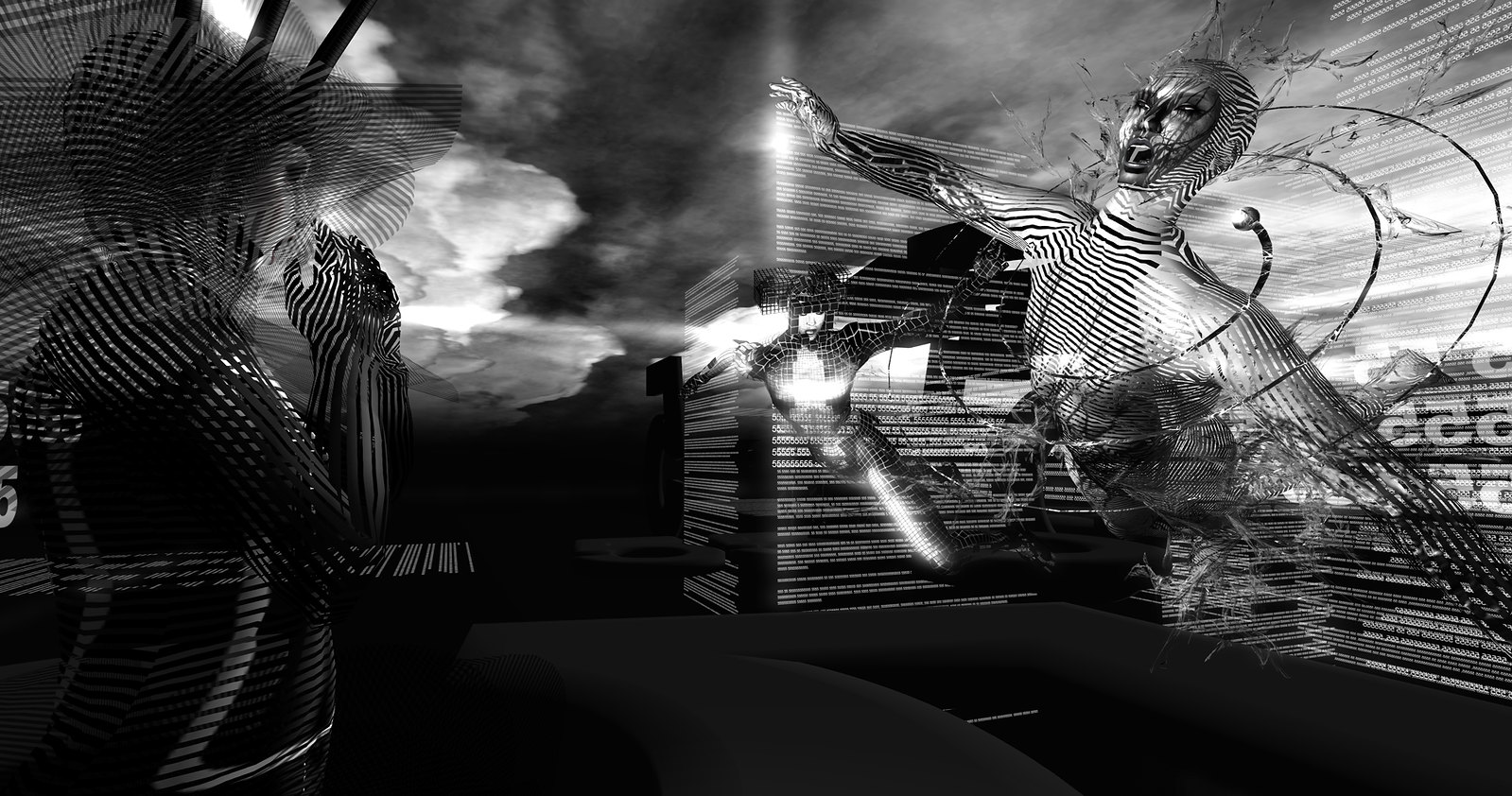
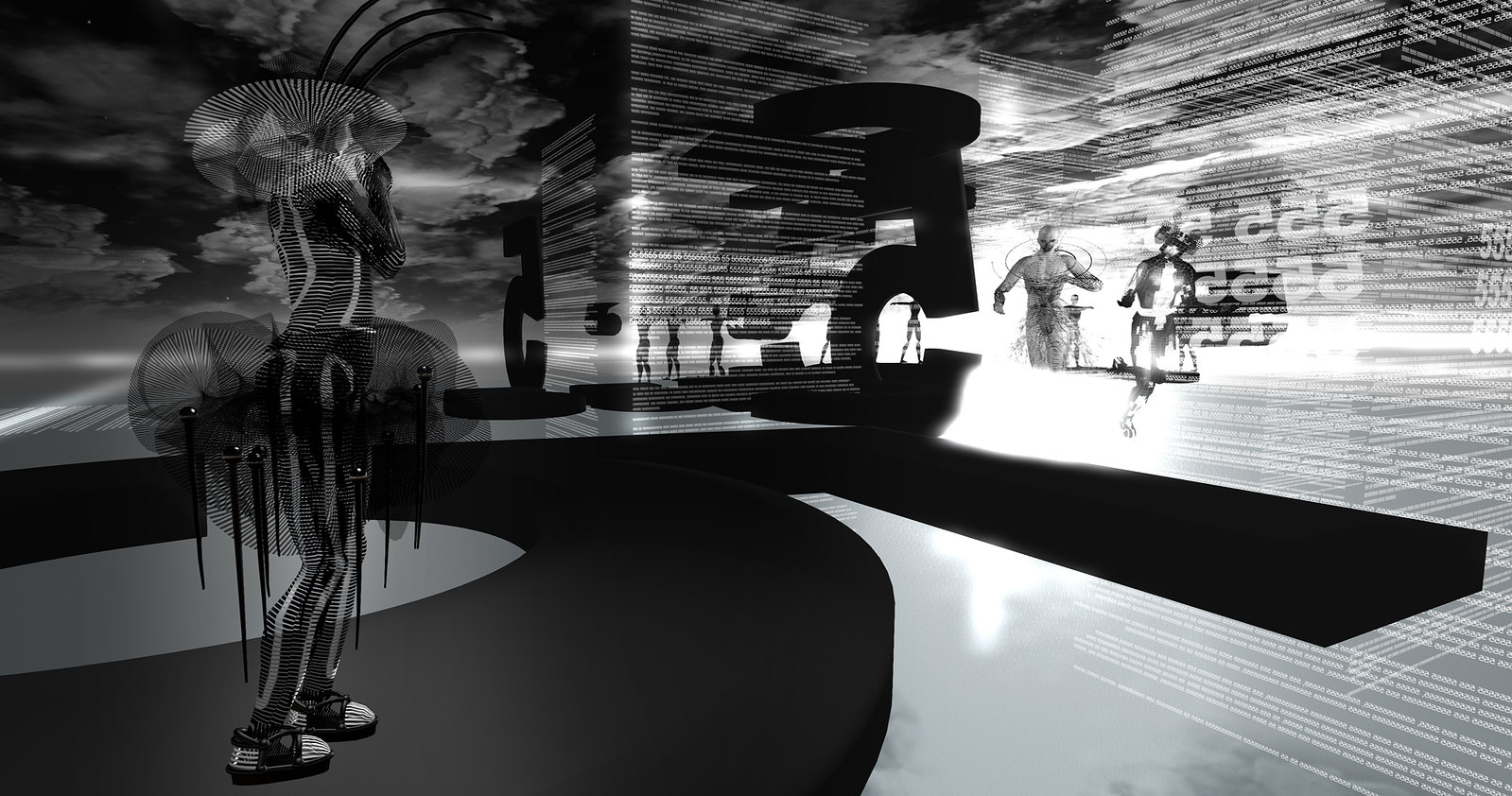
On the screen, space is no longer flat, but multiple layers of textual organization become possible. The dimension of depth is added, foreground and background relations can be constructed, letters can be superimposed upon others, distance and proximity can be simulated. Writing becomes volumetric: letters can suddenly be viewed from all sides, from behind, below, above, they can be rotated and turned around their own axis like real objects in space.
On the screen, space is no longer flat, but multiple layers of textual organization become possible. The dimension of depth is added, foreground and background relations can be constructed, letters can be superimposed upon others, distance and proximity can be simulated. Writing becomes volumetric: letters can suddenly be viewed from all sides, from behind, below, above, they can be rotated and turned around their own axis like real objects in space.
____
Digital poetry actually emerged from the orbit of concrete poetry in the late 1950s in Stuttgart. In fact, the deployment of computers for the artificial generation of poetry was nothing but the logical consequence of the theoretical reflections of an important figure of the concrete poetry movement. One could even say that it was the product of certain aspects of concrete poetry driven to their utmost extremes – which closes the circle rather nicely.
The German scholar, philosopher and poet Max Bense was one of the leading figures of the concrete poets of the Stuttgarter Gruppe, and an important international mediator between various different national groups and factions. He was preoccupied with the study of philosophy, mathematics, technology and theory of science as well as with information theory, semiotics and cybernetics. Bense is certainly the most radical pursuer of objectivity and scientific exactitude, but Eugen Gomringer too emphasised the importance of method, system and structure, and experiments with stochastic, permutational and combinatorial structures can also be observed in many other concrete oeuvres, such as Franz Mon’s and those of the Wiener Gruppe.
In his Einführung in die informationstheoretische Ästhetik. Grundlegung und Anwendung in der Texttheorie from 1969, Bense describes “aesthetic states” of texts as defined by their degree of unexpected, surprising and non-trivial occurrence of words. This notion is a direct transfer of Claude E. Shannon’s definition of information as “unexpected, unpredictable news” into the realms of the aesthetic.
To my knowledge, Bense and his students were the very first ever to deploy computers for purely aesthetic purposes in order to produce stochastic, machine-generated poetry. They deployed the random function of computers for the generation of “unlikely, highly selective and non-trivial” sequences – which is Bense’s defintion of what makes a text aesthetic rather than functional. In 1959, in the computer lab of the ‘Technische Hochschule’, Theo Lutz fed vocabulary taken from Franz Kafka’s Das Schloss into a Zuse Z 22, and wrote a program determining several rules of combination, and thus generated the first artificial, chance determined literary text.
The German scholar, philosopher and poet Max Bense was one of the leading figures of the concrete poets of the Stuttgarter Gruppe, and an important international mediator between various different national groups and factions. He was preoccupied with the study of philosophy, mathematics, technology and theory of science as well as with information theory, semiotics and cybernetics. Bense is certainly the most radical pursuer of objectivity and scientific exactitude, but Eugen Gomringer too emphasised the importance of method, system and structure, and experiments with stochastic, permutational and combinatorial structures can also be observed in many other concrete oeuvres, such as Franz Mon’s and those of the Wiener Gruppe.
In his Einführung in die informationstheoretische Ästhetik. Grundlegung und Anwendung in der Texttheorie from 1969, Bense describes “aesthetic states” of texts as defined by their degree of unexpected, surprising and non-trivial occurrence of words. This notion is a direct transfer of Claude E. Shannon’s definition of information as “unexpected, unpredictable news” into the realms of the aesthetic.
To my knowledge, Bense and his students were the very first ever to deploy computers for purely aesthetic purposes in order to produce stochastic, machine-generated poetry. They deployed the random function of computers for the generation of “unlikely, highly selective and non-trivial” sequences – which is Bense’s defintion of what makes a text aesthetic rather than functional. In 1959, in the computer lab of the ‘Technische Hochschule’, Theo Lutz fed vocabulary taken from Franz Kafka’s Das Schloss into a Zuse Z 22, and wrote a program determining several rules of combination, and thus generated the first artificial, chance determined literary text.
____
Perhaps the most important aspect of combinatorial and chance-determined works is the surprise moment: the results of chance productions are unpredictable, they display features which astound even the artists themselves. Chance is effectively deployed as a tool to transgress the subjective powers of imagination, to go beyond the producer’s limits of comprehension in an attempt to arrive at results which transcend both cultural, psychological and intellectual boundaries.
This hybrid between poem and game forces the recipient into activity, and evokes the oft-cited game state that Eugen Gomringer has defined as another important feature of concrete poetry. The constellation, Gomringer writes, is an offer of a fixed set of parameters, within which the reader is asked to take up the ball that the poet threw and to playfully create meaning by combining and relating the given elements in a creative fashion.
This hybrid between poem and game forces the recipient into activity, and evokes the oft-cited game state that Eugen Gomringer has defined as another important feature of concrete poetry. The constellation, Gomringer writes, is an offer of a fixed set of parameters, within which the reader is asked to take up the ball that the poet threw and to playfully create meaning by combining and relating the given elements in a creative fashion.
____
Other concrete poets too have explored the possibilities of computers for their purposes, amongst them Reinhard Doehl, Emmett Williams and Augusto de Campos. Augusto de Campos uses the web primarily as a transmission medium for his poems, and exhibits static representations of concrete poems, some of them equipped with a soundtrack, usually recordings of a reading, such as “tensao” (1956) and “cidade/city/cité” (1975). In these pieces, the visual and the acoustic dimension do not enter into an innovative dialogue, as in more complex digital works, but remain separate entities.
And it is Augusto de Campos too who called for “new spatio-temporal modes of apprehension of the text by the reader”, arguing that concrete poetry has drastically redefined poetic space and poetic temporality and our perception of it.
And it is Augusto de Campos too who called for “new spatio-temporal modes of apprehension of the text by the reader”, arguing that concrete poetry has drastically redefined poetic space and poetic temporality and our perception of it.
____
Rita Raley, the editor of the September 2006 issue of the Iowa Review, has dedicated a whole edition to what she calls the “spatial turn” of digital writing.
In her introductory essay “Writing 3D”, Raley calls for a new type of reading, “deep reading”, a new type of analysis similar to the Jamesonian “archisemiotics” which acknowledges the semantic significance of spatial design and takes into account the new dimension of writing, the extension of poetic space into the third dimension. Raley argues that those multi-dimensional works that integrate the z-axis into their repertoire require a fundamental reorientation of spatial perspective and new critical frameworks for their analysis. A fourth type of reading becomes necessary, volumetric reading along the z-axis, “reading surface to depth and back again.” “The unit of poetic analysis has shrunk from line to word to letter and now we have need of another unit”, she writes: “the three-dimensional projecting plane.”
In her introductory essay “Writing 3D”, Raley calls for a new type of reading, “deep reading”, a new type of analysis similar to the Jamesonian “archisemiotics” which acknowledges the semantic significance of spatial design and takes into account the new dimension of writing, the extension of poetic space into the third dimension. Raley argues that those multi-dimensional works that integrate the z-axis into their repertoire require a fundamental reorientation of spatial perspective and new critical frameworks for their analysis. A fourth type of reading becomes necessary, volumetric reading along the z-axis, “reading surface to depth and back again.” “The unit of poetic analysis has shrunk from line to word to letter and now we have need of another unit”, she writes: “the three-dimensional projecting plane.”
____
Even though digital works seem more “concrete” than many concrete works in certain respects, they are immaterial, merely an array of pixels on the screen, a representation of binary data constituted of a string of zeros and ones with no physical, material body whatsoever. Paradoxically, the simulation of concreteness is the result of very advanced abstract processes.
____
Jim Andrews even talks of “langwidgets” – language as a thing, as an object in the full sense of the word. Behavior can be inscribed into letters, and letters are put on the scene like actors.
Operative, effective program codes, as John Cayley points out, “instantiate a genuinely ‘performative’ textuality, a textuality which ‘does’ something, which alters the behaviour of a system.” This brings up the issue of time: speed and duration of reception can now be programmed, temporal structures can be inscribed into the work and the reception process can thus be carefully staged-managed in advance.
Operative, effective program codes, as John Cayley points out, “instantiate a genuinely ‘performative’ textuality, a textuality which ‘does’ something, which alters the behaviour of a system.” This brings up the issue of time: speed and duration of reception can now be programmed, temporal structures can be inscribed into the work and the reception process can thus be carefully staged-managed in advance.
____
Many digital poems also illustrate the concept of the autonomous linguistic “Eigenwelt” that Gomringer emphasises in his writings. More than ever before, text is represented for its graphic qualities, or, less frequently, for its acoustic ones, and its representative function is just one amongst three possible textual roles. Concrete poems, Gomringer writes, are not poems “about something but concrete realities in themselves.”
____
It is not the concrete poets who were the first to have aimed conceptually for the effects which could be fully realized in digital poetry, but the Italian Futurists. In 1916 already, F.T. Marinetti and his comrades foretold the downfall of the book in their manifesto “The Futurist Cinema” from 1916.64 Moreover, they also envisaged the following:
“Filmed Words-In-Freedom in Movement (synoptic tables of lyric values – dramas of humanized or animated letters – orthographic dramas – typographical dramas – geometric dramas – numeric sensibility, etc.).”
This prophetic vision of the Futurists seems to corroborate very clearly one of Walter Benjamin’s theses. In “The Work of Art in the Age of Mechanical Reproduction” Benjamin declared that artists tend to aim for effects which can be realised and effectuated only with the help of new technologies:
“One of the foremost tasks of art has always been the creation of a demand which could be fully satisfied only later. The history of every art form shows critical epochs in which a certain art form aspires to effects which could be fully obtained only with a changed technical standard, that is to say, in a new art form.”
This prophetic vision of the Futurists seems to corroborate very clearly one of Walter Benjamin’s theses. In “The Work of Art in the Age of Mechanical Reproduction” Benjamin declared that artists tend to aim for effects which can be realised and effectuated only with the help of new technologies:
“One of the foremost tasks of art has always been the creation of a demand which could be fully satisfied only later. The history of every art form shows critical epochs in which a certain art form aspires to effects which could be fully obtained only with a changed technical standard, that is to say, in a new art form.”
____
Andrews, Jim
Benjamin, Walter. “The Work of Art in the Age of Mechanical Reproduction”. In: Illuminations. Edited by Hannah Arendt. London: Fontana Press, 1992, p. 230.
Bense, Max Einführung in die informationstheoretische Ästhetik. Grundlegung und Anwendung
in der Texttheorie. Reinbek bei Hamburg: Rowohlt, 1969.
Cayley, John “The Code is Not the Text (unless it is the Text)”. In: Friedrich W. Block, Christiane Heibach, Karin Wenz (eds.), p0es1s. Ästhetik digitaler Poesie/The Aesthetics of Digital Poetry. Ostfildern-Ruit: Hatje Cantz Verlag, 2004.
Cramer, Florian “Netzkunst und konkrete Poesie (2001). http://www.netzliteratur.net/cramer/netzkunst konkrete poesie.htm Accessed 15 12 2013
Gomringer, E., & Rothenberg, J. (1968). The book of hours, and Constellations: Being poems of Eugen Gomringer (Vol. 1). Something Else Press.
Hayles, N. Katherine, How we became Posthuman. Virtual Bodies in Cybernetics, Literature and
Informatics. Chicago; London: The University of Chicago Press, 1999.
F.T. Marinetti, Bruno Corra, Emilio Settimielli, Arnaldo Ginna, Giacomo Balla and Remo Chiti, “The Futurist Cinema” (1916). In: Umbro Apollonio (ed.), Futurist Manifestos. New York: The Viking Press, 1973.
Raley, Rita “Editor’s Introduction: Writing 3D”. Iowa Review, September 2006, Volume 8, no 3.
http://www.uiowa.edu/~iareview/mainpages/new/september06/raley/editorsintro.html Accessed 15 12 2013
- “The Battle of Poetry against itself and the forces of dullness” (2002 – updated 2005). http://www.vispo.com/arteroids/indexenglish.htm
- “Stir Frys and Cut Ups” (1999). At: http://www.vispo.com/StirFryTexts/text.html
- “DIGITAL LANGU(IM)AGE. language and image as objects in a field” (1998). At: http://www.vispo.com/writings/essays/jimarticle.htm.
Benjamin, Walter. “The Work of Art in the Age of Mechanical Reproduction”. In: Illuminations. Edited by Hannah Arendt. London: Fontana Press, 1992, p. 230.
Bense, Max Einführung in die informationstheoretische Ästhetik. Grundlegung und Anwendung
in der Texttheorie. Reinbek bei Hamburg: Rowohlt, 1969.
Cayley, John “The Code is Not the Text (unless it is the Text)”. In: Friedrich W. Block, Christiane Heibach, Karin Wenz (eds.), p0es1s. Ästhetik digitaler Poesie/The Aesthetics of Digital Poetry. Ostfildern-Ruit: Hatje Cantz Verlag, 2004.
Cramer, Florian “Netzkunst und konkrete Poesie (2001). http://www.netzliteratur.net/cramer/netzkunst konkrete poesie.htm Accessed 15 12 2013
Gomringer, E., & Rothenberg, J. (1968). The book of hours, and Constellations: Being poems of Eugen Gomringer (Vol. 1). Something Else Press.
Hayles, N. Katherine, How we became Posthuman. Virtual Bodies in Cybernetics, Literature and
Informatics. Chicago; London: The University of Chicago Press, 1999.
F.T. Marinetti, Bruno Corra, Emilio Settimielli, Arnaldo Ginna, Giacomo Balla and Remo Chiti, “The Futurist Cinema” (1916). In: Umbro Apollonio (ed.), Futurist Manifestos. New York: The Viking Press, 1973.
Raley, Rita “Editor’s Introduction: Writing 3D”. Iowa Review, September 2006, Volume 8, no 3.
http://www.uiowa.edu/~iareview/mainpages/new/september06/raley/editorsintro.html Accessed 15 12 2013
____
The following posts have been extracted fromLori Emerson's 2006 article Numbered Space and Topographic Writing.
- APA: Emerson, L. (2006). Numbered Space and Topographic Writing. LEA, 14(05-06). http://tinyurl.com/omxykls Accessed on 14 12 2013
- Chicago: Lori Emerson. "Numbered Space and Topographic Writing." LEA 14, no. 05-06 (2006). http://tinyurl.com/omxykls Accessed on 14 12 2013
____
The cultural trend toward the mathematicization of space has brought about the mathematicization of writing to then argue that many poems — digital as well as paper-based — that are kinetic and/or generated model themselves on mathematical modes of thinking. I see these poems reflecting thinking that is based on either Euclidean or non-Euclidean principles of mathematics—principles which can then be used to ultimately account for a variety of paper-based and digital poems that are kinetic and/or generated.
____
Digital poets continue to attempt to exploit the medium of the word to more accurately represent our desire to have a full experience of and through language as a form of life — only now, through movement, generation, interactivity, they are able to express visually the life-like qualities of words.
What is fundamental in that conceptual/perceptual shift brought on by the digital is that the digital realm offers us the opportunity to represent (not necessarily conceive of) space in different or expanded terms than that of paper-based writing; and, further, this sense of space therefore requires that we come up with a different set of literary terms for the interpretation of certain digital texts. Despite the inseparability of space and time in these digital pieces — an inseparability often marked by text that moves and unfolds in space — solely for the sake of brevity this paper will primarily center on space.
The subject-matter of poetry is not that ‘collection of solid, static objects extended in space’ but the life that is lived in the scene that it composes; and so reality is not that external scene but the life that is lived in it. Reality is things as they are. The general sense of the word proliferates its special senses. It is a jungle in itself (Stevens, 658).
What is fundamental in that conceptual/perceptual shift brought on by the digital is that the digital realm offers us the opportunity to represent (not necessarily conceive of) space in different or expanded terms than that of paper-based writing; and, further, this sense of space therefore requires that we come up with a different set of literary terms for the interpretation of certain digital texts. Despite the inseparability of space and time in these digital pieces — an inseparability often marked by text that moves and unfolds in space — solely for the sake of brevity this paper will primarily center on space.
The subject-matter of poetry is not that ‘collection of solid, static objects extended in space’ but the life that is lived in the scene that it composes; and so reality is not that external scene but the life that is lived in it. Reality is things as they are. The general sense of the word proliferates its special senses. It is a jungle in itself (Stevens, 658).

____
Concrete poets are particularly obvious pre-cursors to digital poetry; through an attempt to draw attention to the materiality of both word and the medium of the page as well as an emphasis on the physicality of language, the constructedness and flexibility of meaning.
But what if a poem is based upon a conception of space as “multiple, variable, and vibrant” — where the literal ground is always shifting and heterogeneous — then how are we to understand the text? Or, to put it in another way, what if the ground upon which the poem is built (and only a digital poem could accomplish this) is not Platonic—is not, as Brian Rotman puts it, an ideal realm “‘out there’ somewhere, existing prior to human beings and their culture, untouched by change, independent of energy and matter, beyond the confines and necessities of space and time . . .” (p. 127)? We could still try to use rhythm, rhyme, line-breaks and so on to understand the poem but only if it were assumed that the resulting reading would be utterly contingent and, since the text could completely change in only a brief moment, such a reading would also ultimately tell us very little about the poem — or it would only tell us that it is comprised of uncountable difference.
But what if a poem is based upon a conception of space as “multiple, variable, and vibrant” — where the literal ground is always shifting and heterogeneous — then how are we to understand the text? Or, to put it in another way, what if the ground upon which the poem is built (and only a digital poem could accomplish this) is not Platonic—is not, as Brian Rotman puts it, an ideal realm “‘out there’ somewhere, existing prior to human beings and their culture, untouched by change, independent of energy and matter, beyond the confines and necessities of space and time . . .” (p. 127)? We could still try to use rhythm, rhyme, line-breaks and so on to understand the poem but only if it were assumed that the resulting reading would be utterly contingent and, since the text could completely change in only a brief moment, such a reading would also ultimately tell us very little about the poem — or it would only tell us that it is comprised of uncountable difference.
____
Simon Biggs in his 2003 “web art” work Book of Books, clearly sees language and machines as intertwined. As he writes in Computing the Sublime, “. . . it can be established that the computer is firstly a language machine. It is a machine that is formed with language (symbolically) and which operates as a semiosis, perhaps sometimes as a form of poesis, on language.” However, despite his mention of semiosis, in Book of Books this vision of the intertwining of language and machine is not in the sense of how they are both socially situated and culturally constructed, but in the sense that language, like mathematics, is a tool to be used, a tool entirely separate from its users. In his artist’s statement Biggs writes:
Rather than monkeys typing we have a computer program tirelessly generating random words and inserting them into the resulting ever expanding text . . . we can imagine that this system might, given an infinite period of time and processing power, generate such a book ... Eventually, after a reasonable period of time . . . the text is reduced to a one pixel font size at which point it resembles our new universal language, binary code. All languages are thus seen to be one and the same in a demonstration of what the term convergence media might really imply, as the erasure of difference leads to the text becoming unreadable.
What is so curious about this statement is that on the one hand the pieces of Book of Books show language, like numbers in Euclidean arithmetic, as an infinite plane of possibility that, again, exists apart from the vagaries of space, time, and users. But on the other hand, while Book of Books might appear to triumphantly represent the mathematicization of space that the computer offers us, the ultimate unreadability of Biggs’ texts seems in fact to point to a desire not just for language itself but for language to remain untouched by the zeroes and ones of an encroaching digitalization.
Rather than monkeys typing we have a computer program tirelessly generating random words and inserting them into the resulting ever expanding text . . . we can imagine that this system might, given an infinite period of time and processing power, generate such a book ... Eventually, after a reasonable period of time . . . the text is reduced to a one pixel font size at which point it resembles our new universal language, binary code. All languages are thus seen to be one and the same in a demonstration of what the term convergence media might really imply, as the erasure of difference leads to the text becoming unreadable.
What is so curious about this statement is that on the one hand the pieces of Book of Books show language, like numbers in Euclidean arithmetic, as an infinite plane of possibility that, again, exists apart from the vagaries of space, time, and users. But on the other hand, while Book of Books might appear to triumphantly represent the mathematicization of space that the computer offers us, the ultimate unreadability of Biggs’ texts seems in fact to point to a desire not just for language itself but for language to remain untouched by the zeroes and ones of an encroaching digitalization.
____
John Cayley is another exception to paper-bound thinking: His work has evolved from an engagement with interactivity through movement, co-creation and continuous generation. Cayley writes: “There is a stable text underlying its continuously changing display and this text may occasionally rise to the surface of normal legibility in its entirety. However, overboard is installed as a dynamic linguistic ‘wall-hanging,’ an ever-moving ‘language painting.’”
____
Biggs, Simon. (2003), Book of Books http://www.littlepig.org.uk/bookofbooks/statement.htm Accessed on 14 12 2013.
Cayley, John. (2004), Overboard: An Example of Ambient Time-Based Poetics in digital art, Dichtung Digital, http://www.dichtung-digital.org/2004/2/Cayley/index.htm Accessed on 14 12 2013.
Rotman, Brian. Mathematics as Sign: Writing, Imagining, Counting (Stanford: Stanford University Press, 2000).
Stevens, Wallace. (1965), The Necessary Angel: Essays on Reality and the Imagination, Vintage Books, NY.
Cayley, John. (2004), Overboard: An Example of Ambient Time-Based Poetics in digital art, Dichtung Digital, http://www.dichtung-digital.org/2004/2/Cayley/index.htm Accessed on 14 12 2013.
Rotman, Brian. Mathematics as Sign: Writing, Imagining, Counting (Stanford: Stanford University Press, 2000).
Stevens, Wallace. (1965), The Necessary Angel: Essays on Reality and the Imagination, Vintage Books, NY.
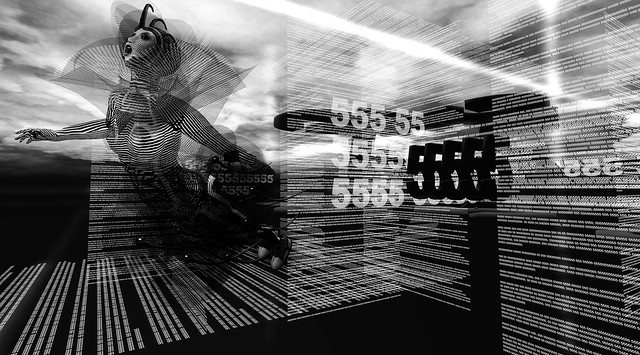
____
The following posts are extractions from Manuel Portola's 2006 article Concrete and Digital Poetics.
- APA: Portela, M. (2006). Concrete and Digital Poetics, LEA, Vol 14 Issue 05 - 06, http://tinyurl.com/pwvqvu5 Accessed on 13 12 2013
- Chicago: Manuel Portola, Concrete and Digital Poetics, LEA, Vol 14 Issue 05 - 06, (2006) http://tinyurl.com/pwvqvu5 Accessed on 13 12 2013
____
There is an intrinsic connection between concrete poetics and digital poetics as a theory of poetry for the digital medium. This link is clearly seen in the use of concrete poems as storyboards and scripts for electronic texts, both in composing text for graphic interface static display and for animation.
It is as if the concrete approach to language and form, because of its constructivist and objectivist emphasis, anticipated the kind of reflection on media set in motion by the electronic page. Close attention to the visibility of language and to the materiality of reading, two of the central tenets of concretist texts, also underlie many of the poetic attempts to use the specific properties of electronic textuality in digital forms.
It is as if the concrete approach to language and form, because of its constructivist and objectivist emphasis, anticipated the kind of reflection on media set in motion by the electronic page. Close attention to the visibility of language and to the materiality of reading, two of the central tenets of concretist texts, also underlie many of the poetic attempts to use the specific properties of electronic textuality in digital forms.
____
The adoption of computers as a means for literary creation has been fostered by concrete poetics. Because of its internalization of a theory of language as a structural system of signs, the concrete poem laboratory explores the projection of the paradigmatic axis into the syntagmatic axis. This probabilistic game with phonetic and semantic similarities and differences is spatialized on the page, in such a way that it foregrounds the fact that a text is always a set of instructions for reading itself.
Consequently, the combinatorial procedures that have generated the rhetorical and typographic code of the poem become visible on the textual surface.
In retrospect, the poem appears as a script of meaning, even if this meaning is not entirely determinable.
This is the kind of metalinguistic analysis that signals concrete self-reference to the poem’s information code. For concrete aesthetics, the dynamics of a syntactical combination that resulted from phonetic and graphical attractions and lexical cross-breeding is the guiding principle of composition.
Consequently, the combinatorial procedures that have generated the rhetorical and typographic code of the poem become visible on the textual surface.
In retrospect, the poem appears as a script of meaning, even if this meaning is not entirely determinable.
This is the kind of metalinguistic analysis that signals concrete self-reference to the poem’s information code. For concrete aesthetics, the dynamics of a syntactical combination that resulted from phonetic and graphical attractions and lexical cross-breeding is the guiding principle of composition.
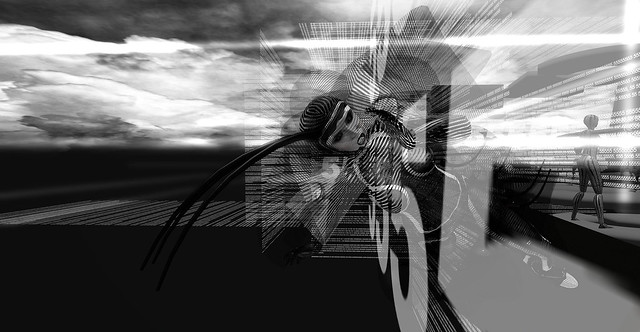
____
Its conscious and subconscious workings may be observed both below and above the word level: in the first case in the agglutinations, prefixes, infixes, suffixes, and various types of fragmentation of both lexemes, morphemes and even graphemes; in the second case, at the higher level of syntactic units, sentences, and texts. Thus it is a poetics of spoken and written language, as much as it is a poetics of hearing and reading. Its hermeneutics starts at the physiological processing of audiovisual input, which transmutes the poem into a cyborg, that is, a cybernetic simulation of meaning as a specific processing of information.
From this point of view, the concrete poem is a kind of language generator which provides a microcosm both of the linguistic processes of word and sentence creation, and of the more basic and fundamental structuring processes of the phonetic, syntactical, semantic, and pragmatic elements that produce language. Language is not a mere repertoire of given elements, classes of elements, and combinations of those classes, but it is above all the possibility of expanding elements, classes, and combinations.
It is not a matter of coincidence that the poem about the poem (always a serious candidate to being the most frequent topic in the history of any type of poetry) has become perhaps the archi-theme of concrete poetry, as if every single poem had to be a ars poetica at the same time.
From this point of view, the concrete poem is a kind of language generator which provides a microcosm both of the linguistic processes of word and sentence creation, and of the more basic and fundamental structuring processes of the phonetic, syntactical, semantic, and pragmatic elements that produce language. Language is not a mere repertoire of given elements, classes of elements, and combinations of those classes, but it is above all the possibility of expanding elements, classes, and combinations.
It is not a matter of coincidence that the poem about the poem (always a serious candidate to being the most frequent topic in the history of any type of poetry) has become perhaps the archi-theme of concrete poetry, as if every single poem had to be a ars poetica at the same time.
____
The digital medium, especially after the combined development of hypertext and large-scale computer networks, has led to the creation of literary genres that are specifically digital, i.e., genres that adopt the properties of the software and of the means of computational display as structural elements of poetic and narrative forms. Moreover, the digital medium has enabled authors to formalize the intra-textual and inter-textual connections, and it has also permitted the development of certain textual virtualities that are inherent to various typographical genres.
____
The following posts are extractions from Robert et al's 2012 article Creative Practice and Experimental Method in Electronic Literature and Human Experimental Psychology.
- APA: Roberts, A. M., Otty, L., Fischer, M. H., & Katharina, A. (2012) Creative Practice and Experimental Method in Electronic Literature and Human Experimental Psychology, Dichtung Digital. No. 42 – 2012-12-20, http://tinyurl.com/nne3pee Accessed on 12 12 2013
- Chicago: Andrew Michael Roberts, Lisa Otty, Martin H. Fischer and Anna Katharina Schaffner, Creative Practice and Experimental Method in Electronic Literature and Human Experimental Psychology, Dichtung Digital, No. 42 – 2012-12-20, (2012) http://tinyurl.com/nne3pee Accessed on 12 12 2013

____
In the broadest terms, an experiment suggests the staging of some process in order to “see what happens.” Psychological research typically has a pre-arranged dimension of evidence: both what is to be measured and the scale of that measurement are decided in advance. “Experimental” creative practice also involves designing a process or context for a human experience, but “what might happen” is left more open—and is not usually measured in any explicit way. This raises the question of what the feedback loop is in such creative practice – how does the “result” of experimentation feed back into future work?
Katherine Hayles sees literature as transforming implicit (bodily) knowledge into conscious knowledge, but also calling into question conscious knowledge. In this instance, the feedback is not a flow from the participant and apparatus which is then managed by the experimenter (the scientist or artist), but an effect which can presumably be experienced both by participant / reader and artist. (132)
Hayles’s comment is an instance of the way in which critical and theoretical writing on new media practice sometimes applies the language of scientific experiment to the analysis of creative practice, suggesting a convergence in discourse. Other examples are found in the work of new media theorist Mark Hansen, who writes about “cognitive activity” (3) and “the flow of data” (2), and suggests that "by placing the embodied viewer-participant into a circuit with information, the installations and environments [created by contemporary media artists] ... function as laboratories for the conversion of information into corporeally apprehensible images." (Hansen 11)
Katherine Hayles sees literature as transforming implicit (bodily) knowledge into conscious knowledge, but also calling into question conscious knowledge. In this instance, the feedback is not a flow from the participant and apparatus which is then managed by the experimenter (the scientist or artist), but an effect which can presumably be experienced both by participant / reader and artist. (132)
Hayles’s comment is an instance of the way in which critical and theoretical writing on new media practice sometimes applies the language of scientific experiment to the analysis of creative practice, suggesting a convergence in discourse. Other examples are found in the work of new media theorist Mark Hansen, who writes about “cognitive activity” (3) and “the flow of data” (2), and suggests that "by placing the embodied viewer-participant into a circuit with information, the installations and environments [created by contemporary media artists] ... function as laboratories for the conversion of information into corporeally apprehensible images." (Hansen 11)
____
The human subject of aesthetic “experiments”—in the sense of “experimental” literary forms and practice, often associated with the avant-garde—is a potentially revolutionary or radicalisable political and social subject. Many experimental avant-garde poets and post-war concrete poets were operating on the assumption that poetic, linguistic and disciplinary transgressions enacted in their poetries would generate psychological and ideological changes in their readers. By breaking the linguistic contract and unmasking its arbitrary and convention-based foundation, the encounter with the avant-garde text is to create rupture, to “shock” readers, to make them question their habitual perception strategies and assumptions about literature, language and, crucially, more wide-ranging socio-political conventions by implication. This belief in the psycho-political transformative power of experimental literatures has been developed further in the realm of post-structuralist theory, most notably by thinkers such as Julia Kristeva, Roland Barthes, Jean Baudrillard, and Michel Foucault. What is at stake in experimental literature, according to them, is not just an exploration of new possibilities for poetry and thought that lie beyond the cognitive boundaries imposed by “ordinary” language, but also a potentially socio-politically revolutionary insight into the constructed nature of our value systems and social conventions.
The disruptive function of avant-garde works is frequently produced by programmatic violations of poetic, linguistic and cognitive-perceptual conventions. These violations include the generation of logical paradox, semantic incongruity, syntactical fragmentation and vacillations between word and image genres that require the reader to shuttle between different perceptual strategies, that is, reading and viewing modes. Whilst the avant-garde experiments are attempts to push further the boundaries imposed by convention on artistic expression, they are also, as discussed earlier, attempts to produce a more critically aware, self-reflexive and in many cases politically radicalised subject.
Biggs is sceptical about the association which is sometimes made between creative practice in contemporary emergent media and the idea of the “avant-garde”; he has argued that the absence of a homogenous mainstream or bourgeois culture in contemporary society (due to the rise of globalisation and multiculturalism), precludes the existence of an effective avant-garde, a position in accord with Peter Bürger’s arguments for the historical nature of the avant-garde project.
The disruptive function of avant-garde works is frequently produced by programmatic violations of poetic, linguistic and cognitive-perceptual conventions. These violations include the generation of logical paradox, semantic incongruity, syntactical fragmentation and vacillations between word and image genres that require the reader to shuttle between different perceptual strategies, that is, reading and viewing modes. Whilst the avant-garde experiments are attempts to push further the boundaries imposed by convention on artistic expression, they are also, as discussed earlier, attempts to produce a more critically aware, self-reflexive and in many cases politically radicalised subject.
Biggs is sceptical about the association which is sometimes made between creative practice in contemporary emergent media and the idea of the “avant-garde”; he has argued that the absence of a homogenous mainstream or bourgeois culture in contemporary society (due to the rise of globalisation and multiculturalism), precludes the existence of an effective avant-garde, a position in accord with Peter Bürger’s arguments for the historical nature of the avant-garde project.
____
In the context of HEP reading is conceptualized as a complex orchestration of perceptual, cognitive and motor processes in the service of extracting meaning from print. Perceptual processes include the encoding and identification of letters, while cognitive processes include grapheme-to-phoneme mapping for letters and letter combinations, semantic comprehension of words and syntactic ambiguity resolution across entire sentences. Finally, motor processes involve the planning and execution of targeted eye movements from one word to the next in order to integrate the spatially distributed information.
At the perceptual level, manipulations of line length, font, and contrast polarity (white characters on black background or vice versa) have been used in experiments aimed at improving simple legibility. For example, we know from classical work by Tinker that readers benefit from medium-long lines and that high positive contrast polarity (black on white) is more reader-friendly than high negative contrast polarity (white on black) or low contrast (grey text). Contrast manipulations have been used to study the interplay between overt attention shifts (eye movements) and so-called covert attention shifts (which occur independent of eye movements and refer to our ability to process information from peripheral vision). Differences in contrast or contrast polarity are common in works of electronic literature.
An HEP use of contrast effects is found in a study by Reingold and Rayner, who tested whether our covert attention is allocated serially to one word at a time or in parallel across multiple words within a line of text. They presented readers with normal black text on white background that included a single low contrast (faint) word. Once this word was fixated the authors measured the time it took readers to process the next word, also referred to as parafoveal word. If covert attention is deployed serially then the perceptual difficulty of a faint word should not affect processing of the parafoveal (normal) word. This is so because we would only attend to it once the fixated word has been successfully encoded, regardless of whether this is a fast or slow process. However, if we attend to multiple words at the same time, then two alternative predictions emerge: either the perceptual difficulty induced by the low contrast word should withdraw attentional resources from the simultaneous processing of other words, thus prolonging the dwell time of the eyes on the subsequent parafoveal word; or the longer dwell time on the faint word might enable more extensive parallel preprocessing of the parafoveal word, thus reducing the time it would subsequently take to read it. Consistent with the serial model of attention allocation, the authors found that there was indeed a strong effect of perceptual degradation on the dwell time on the faint word, but no penalty for processing the parafoveal word once it was fixated. Part of the point of this experiment was to support a model of the reading process (“the EZ Reader Model”) which distinguishes between “two stages of lexical processing: an early stage (L1), which includes the extraction and identification of the orthographic form of the word, and a later stage (L2), which is solely involved with processing at the phonological and semantic level” (Reingold and Rayner, 745). It was found that the “stimulus quality” of the word (in this instance, how faint or dark it was), affected the first stage but not the second.
At the perceptual level, manipulations of line length, font, and contrast polarity (white characters on black background or vice versa) have been used in experiments aimed at improving simple legibility. For example, we know from classical work by Tinker that readers benefit from medium-long lines and that high positive contrast polarity (black on white) is more reader-friendly than high negative contrast polarity (white on black) or low contrast (grey text). Contrast manipulations have been used to study the interplay between overt attention shifts (eye movements) and so-called covert attention shifts (which occur independent of eye movements and refer to our ability to process information from peripheral vision). Differences in contrast or contrast polarity are common in works of electronic literature.
An HEP use of contrast effects is found in a study by Reingold and Rayner, who tested whether our covert attention is allocated serially to one word at a time or in parallel across multiple words within a line of text. They presented readers with normal black text on white background that included a single low contrast (faint) word. Once this word was fixated the authors measured the time it took readers to process the next word, also referred to as parafoveal word. If covert attention is deployed serially then the perceptual difficulty of a faint word should not affect processing of the parafoveal (normal) word. This is so because we would only attend to it once the fixated word has been successfully encoded, regardless of whether this is a fast or slow process. However, if we attend to multiple words at the same time, then two alternative predictions emerge: either the perceptual difficulty induced by the low contrast word should withdraw attentional resources from the simultaneous processing of other words, thus prolonging the dwell time of the eyes on the subsequent parafoveal word; or the longer dwell time on the faint word might enable more extensive parallel preprocessing of the parafoveal word, thus reducing the time it would subsequently take to read it. Consistent with the serial model of attention allocation, the authors found that there was indeed a strong effect of perceptual degradation on the dwell time on the faint word, but no penalty for processing the parafoveal word once it was fixated. Part of the point of this experiment was to support a model of the reading process (“the EZ Reader Model”) which distinguishes between “two stages of lexical processing: an early stage (L1), which includes the extraction and identification of the orthographic form of the word, and a later stage (L2), which is solely involved with processing at the phonological and semantic level” (Reingold and Rayner, 745). It was found that the “stimulus quality” of the word (in this instance, how faint or dark it was), affected the first stage but not the second.
____
Psychologists, like digital poets, need to manipulate text for striking visual effects. A surprising font-related result in the field of HEP was recently reported by Miellet et al. who designed a text display that would present the letters in a size that compensated for the reduced visual acuity in peripheral compared to central vision. Given that we can resolve most detail at the point of fixation, and gradually less detail in more peripheral vision, text must be presented in a “butterfly” format. In this format, the directly fixated letter of a given word is printed in normal size, the two adjacent letters are printed in slightly larger size, and more distant letters in ever more increasing sizes.
The authors expected that readers would be able to process more text at any given fixation, thus leading to larger saccades (eye-movements from one point to another) and somewhat faster reading rates. However, they found that neither reading rates nor saccade lengths differed reliably between conditions. This result was taken to suggest that the crucial cognitive limitation in reading is not our limited perceptual acuity but our limited amount of attention which does not allow us to process more than a small number of letters at a time.
____
Another experimental procedure with analogies to digital poetry is the Mental Rotation test, in which participants see a shape or letter which has been rotated at various angles. They are asked to identify whether it is “normal” or a mirror image. Speed and accuracy are assessed as a measure of spatial ability. Examples of this test, using both shapes and letters, can be seen in the Stanford Encylopedia of Philosophy entry on “Mental Imagery”. This experimental procedure may be compared with the “dynamic topology” of John Cayley’s work Lens. Created in the CAVE at Brown University, Lens makes use of 3D-simulation technology to present text in (the illusion of) three rather than two dimensions.
"Letters are very good at defining space for literate humans. Letter forms give excellent visual clues concerning relative distance. It would require experimentation in perception and cognition to verify this empirically, but my hypothesis is that, because letter shapes are both complex and familiar (to their readers, to the literate), they are highly suitable as reference shapes for spatiality. Unlike abstract shapes, letters possess an intrinsic scale ... The implication is that virtual 3D structures made from letter forms will have, as it were, an appreciably enhanced spatial structure for literate readers ... it should be possible to “play”—affectively, viscerally—with their form and arrangement in ways that are likely to have aesthetic significance, and some bearing— potentially, ultimately—on literary practice." (Cayley, Interview)
"Letters are very good at defining space for literate humans. Letter forms give excellent visual clues concerning relative distance. It would require experimentation in perception and cognition to verify this empirically, but my hypothesis is that, because letter shapes are both complex and familiar (to their readers, to the literate), they are highly suitable as reference shapes for spatiality. Unlike abstract shapes, letters possess an intrinsic scale ... The implication is that virtual 3D structures made from letter forms will have, as it were, an appreciably enhanced spatial structure for literate readers ... it should be possible to “play”—affectively, viscerally—with their form and arrangement in ways that are likely to have aesthetic significance, and some bearing— potentially, ultimately—on literary practice." (Cayley, Interview)
____
Hansen, Mark B. N. New Philosophy for New Media. Cambridge, MA: MIT P, 2004.
Hayles, N. Katherine. Electronic Literature: New Horizons for the Literary. Notre Dame, IN: U of Notre Dame P, 2008.
Miellet, Sébastian, Patrick J. O’Donnell, and Sara C. Sereno. “Parafoveal Magnification: Visual Acuity does not Modulate the Perceptual Span in Reading.” Psychological Science 20.6 (2009): 721-28.
Reingold, Eyal M, and Keith Rayner. “Examining the Word Identification Stages Hypothesized by the E-Z Reader Model. Psychological Science 17.9 (2006): 742-46.
Tinker, Miles A. Legibility of Print. Iowa: Iowa State UP, 1963.
Hayles, N. Katherine. Electronic Literature: New Horizons for the Literary. Notre Dame, IN: U of Notre Dame P, 2008.
Miellet, Sébastian, Patrick J. O’Donnell, and Sara C. Sereno. “Parafoveal Magnification: Visual Acuity does not Modulate the Perceptual Span in Reading.” Psychological Science 20.6 (2009): 721-28.
Reingold, Eyal M, and Keith Rayner. “Examining the Word Identification Stages Hypothesized by the E-Z Reader Model. Psychological Science 17.9 (2006): 742-46.
Tinker, Miles A. Legibility of Print. Iowa: Iowa State UP, 1963.

____
The following are snippets taken from Loss Pequeño Glazier's 2006 article Code as Language, that may come in useful as quotes.
- APA: Glazier, Loss Pequeño. "Code as Language." LEA 14.05-06 (2006). http://tinyurl.com/nvu6aqm Accessed on December 11 2013.
- Chicago: Loss Pequeño Glazier. "Code as Language." LEA 14, no. 05-06 (2006). http://tinyurl.com/nvu6aqm Accessed on December 11 2013.
____
Writing occurs in space and space is itself part of the process through which writing produces meaning. In digital media, textuality is equally a function of the meaning of space. The materiality of the digital written object differs from that of the print object, but is no less material.
A poetics of dynamic text seeks to engage that delicate edge where language apparatuses meet, slip, and engage, to further the possibilities of the poetic text. Ultimately, a poetics of programming raises the question, where is the writing — in the code or in the displayed language?
If language is defined as written symbols organized into combinations and patterns to express and communicate thoughts and feelings — language that executes — then coding is language.
Language in its written sense, as an agency of mark-making to produce meaning in a given medium: The nature of such agency is not limited to simply recording preexisting, definitive, or idealized thought, rather the act of inscription is itself a process of thinking through thought. Second, the process of inscription is not just about meaning being placed on a given material. Instead, meaning is made through the act of inscribing on the specific material. Further, the act of inscribing engages the visual, spatial, and material modes of, not mark-making, but of meaning making through making marks. Finally, the recorded text is not an ideal or definitive one but is merely one articulation of many possible ones; an exemplar of the specific material and social factors that condition mark-making at that moment. Writing is the registering of an individual iteration of the always dynamic multiple material possibilities of textuality.
As Johanna Drucker has argued the New York Times, for example, draws its content not only from the text that occurs on the page, but from the masthead, the layout, the columns, the subheads on the page. Simply by looking at a New York Times page one knows not to expect a poem by Mallarmé, or a treatise by Mao. Thus meaning is made not just by what the text says but equally by how space is used in the scene of writing. Such a dynamic has been explored to great effect by countless Concrete Poets.
Accordingly, there is no such thing as negative space. The book itself is dependent upon space.
The fact that marks are representational immediately suggests that encoding is writing. Of course, by this definition, one could also say that other forms of mark-making, sculpture, painting, playing an instrument are also writing. I would accept that these other examples are also "writing" if we define writing as an act of engaging a material to explore ideas through the process of working through that given material, physically, socially, and ideologically. The case of encoding is even more closely located to what we might conventionally think of as writing.
Drucker, Johanna, Figuring the Word (New York: Granary, 1998).
A poetics of dynamic text seeks to engage that delicate edge where language apparatuses meet, slip, and engage, to further the possibilities of the poetic text. Ultimately, a poetics of programming raises the question, where is the writing — in the code or in the displayed language?
If language is defined as written symbols organized into combinations and patterns to express and communicate thoughts and feelings — language that executes — then coding is language.
Language in its written sense, as an agency of mark-making to produce meaning in a given medium: The nature of such agency is not limited to simply recording preexisting, definitive, or idealized thought, rather the act of inscription is itself a process of thinking through thought. Second, the process of inscription is not just about meaning being placed on a given material. Instead, meaning is made through the act of inscribing on the specific material. Further, the act of inscribing engages the visual, spatial, and material modes of, not mark-making, but of meaning making through making marks. Finally, the recorded text is not an ideal or definitive one but is merely one articulation of many possible ones; an exemplar of the specific material and social factors that condition mark-making at that moment. Writing is the registering of an individual iteration of the always dynamic multiple material possibilities of textuality.
As Johanna Drucker has argued the New York Times, for example, draws its content not only from the text that occurs on the page, but from the masthead, the layout, the columns, the subheads on the page. Simply by looking at a New York Times page one knows not to expect a poem by Mallarmé, or a treatise by Mao. Thus meaning is made not just by what the text says but equally by how space is used in the scene of writing. Such a dynamic has been explored to great effect by countless Concrete Poets.
Accordingly, there is no such thing as negative space. The book itself is dependent upon space.
The fact that marks are representational immediately suggests that encoding is writing. Of course, by this definition, one could also say that other forms of mark-making, sculpture, painting, playing an instrument are also writing. I would accept that these other examples are also "writing" if we define writing as an act of engaging a material to explore ideas through the process of working through that given material, physically, socially, and ideologically. The case of encoding is even more closely located to what we might conventionally think of as writing.
Drucker, Johanna, Figuring the Word (New York: Granary, 1998).


