____

The following posts have been extracted from John Cayley and Dmitri Lemmerman's 2006 article Lens: The Practice and Poetics of Writing in Immersive VR: A Case Study with Maquette.
  1. APA: Cayley, J., Lemmerman, D., (2006). Lens: The Practice and Poetics of Writing in Immersive VR (A Case Study with Maquette). LEA, 14(05-06).
  2. Chicago: John Cayley, John, and Dmitri Lemmerman., "Lens: The Practice and Poetics of Writing in Immersive VR (A Case Study with Maquette)." LEA 14, no. 05-06 (2006).

____

What is, what will be, the phenomenology and aesthetics of text in 3-D space?

‘Is there a phenomenology of text in space?’ I would answer that there is, but that it is, as it were, constrained. Specifically, in the case of text as writing, it is constrained to surfaces. Text, in this form — as perceptual material object, as a composition of printed or inscribed letters — is two-dimensional. It has no appreciable thickness, and rests, third-dimensionless, on a surface whose thickness is, itself, largely non-signifying. It is often desirable that the actual surface of writing be as thin as possible. Of course there are exceptional cases, where we become aware, for example, of a force producing real depth in a surface that bears a carved or incised piece of lettering, or when the mark-making ‘ink’ is ‘thick,’ literally, as well as figuratively.

____


____

There are also a wide variety of exceptional cases arising from practices of Concrete poetry and poetics, to which we will return. However, typically text is a matter for surfaces. In so far as it dwells in space, it dwells on surfaces. Usually this is an opaque and resistant surface, through which other physical objects, including ourselves, cannot pass; not, at least, without damaging or destroying the writing. Of course, surfaces that bear writing do themselves have locations in real space. They are, typically, portable and often gathered into piles or collections of paper leaves. In the West, traditionally, the codex book is where writing most often dwells.

In the World of Letters, writing in real space occurs on signs, on monumental inscriptions, and on objects that require labels, chiefly containers or vehicles. These are all special surfaces which are very much site and context specific, set up to function in an exact and particular manner — to inform, warn, attract custom and attention; to celebrate, memorialize, identify, and so on. Note that only rarely is the text displayed on surfaces in space anything other than functional; such text requires to be inscribed and read out of necessity rather than rhetorical desire.

____

Constraints on the spatial manifestation of written text has a further implication relating to the characteristics of writing as graphic form. Because writing is typically located either on portable surfaces or on surfaces that are intended to be read in very specific contexts and for very specific purposes, we have a very clear idea of its graphic constituents’ — that is, its letters’ — size. Letters must always be a good size for reading, big enough to allow us to distinguish the differences which constitute symbolic structure, small enough to copy-fit a significant gobbet of text in the available surface area. Letter forms are, in the Structuralist’s sense, arbitrary. To support the differences they establish, they must be relatively complex shapes, and yet they must become familiar, in the culture where they are current, especially to literate viewers, for whom their very differentiated complexities enable reading. Graphically, and in terms of phenomenology, this gives us — culturally, experientially — a vocabulary of graphic forms about whose size we have very specific ideas and expectations.

____


____

Screens are a particular case of writing surface and, manifestly, they are shifting our experience of written language, although more slowly than might have been expected. In the early days of personal and networked computing, screens carried text, but did so in a manner that ran counter to the highly developed aesthetics of print and literary culture. Moreover, this occurred at the same time that screens were establishing themselves, in the form of television, as the visual business end of receivers for broadcast representations of distant real-world spaces. To do so it employs conventional, illusionistic spatial representations, generated by and adapted from lens optics, photography and film. Today, when we use a computer screen, not only do we expect it to be capable of these visual representations, so familiar from film and television, we also demand a fair degree of spatial representation in our software tools, even when all we are doing is, for example, typing.

____

Even the flat (third-dimensionless) screen of the programmaton, because of its increasingly implicated relations with film and television, invites our engagement with the illusionistic, naturalistic representation of space, and this continues to have implications for any aestheticized presentation of text on the screen, on the making, that is, of screen-based literal art. To be more specific, it has implied another and, for some readers, a promisingly ‘new’ relationship with the phenomenology of text in space, all without directly addressing the issues and problems as such.

I would argue that the effect on literal art and poetics in new media — the effect of this failure to address directly the phenomenology of text and the ambiguities of the display media — has been to push literal art in the direction of a Concrete poetics. By Concrete, I mean a poetics in which written language — letters and words — take on characteristics of other kinds of objects in order to generate rhetorical and aesthetic affect and significance.

____


____

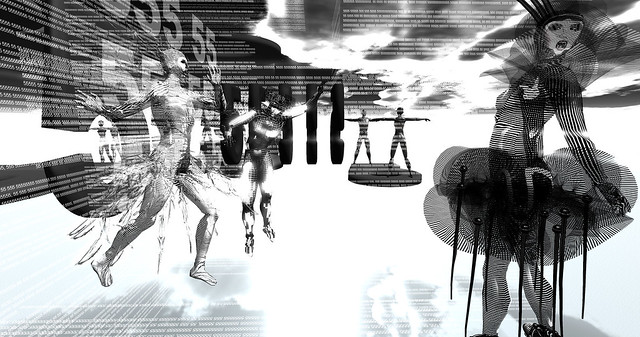
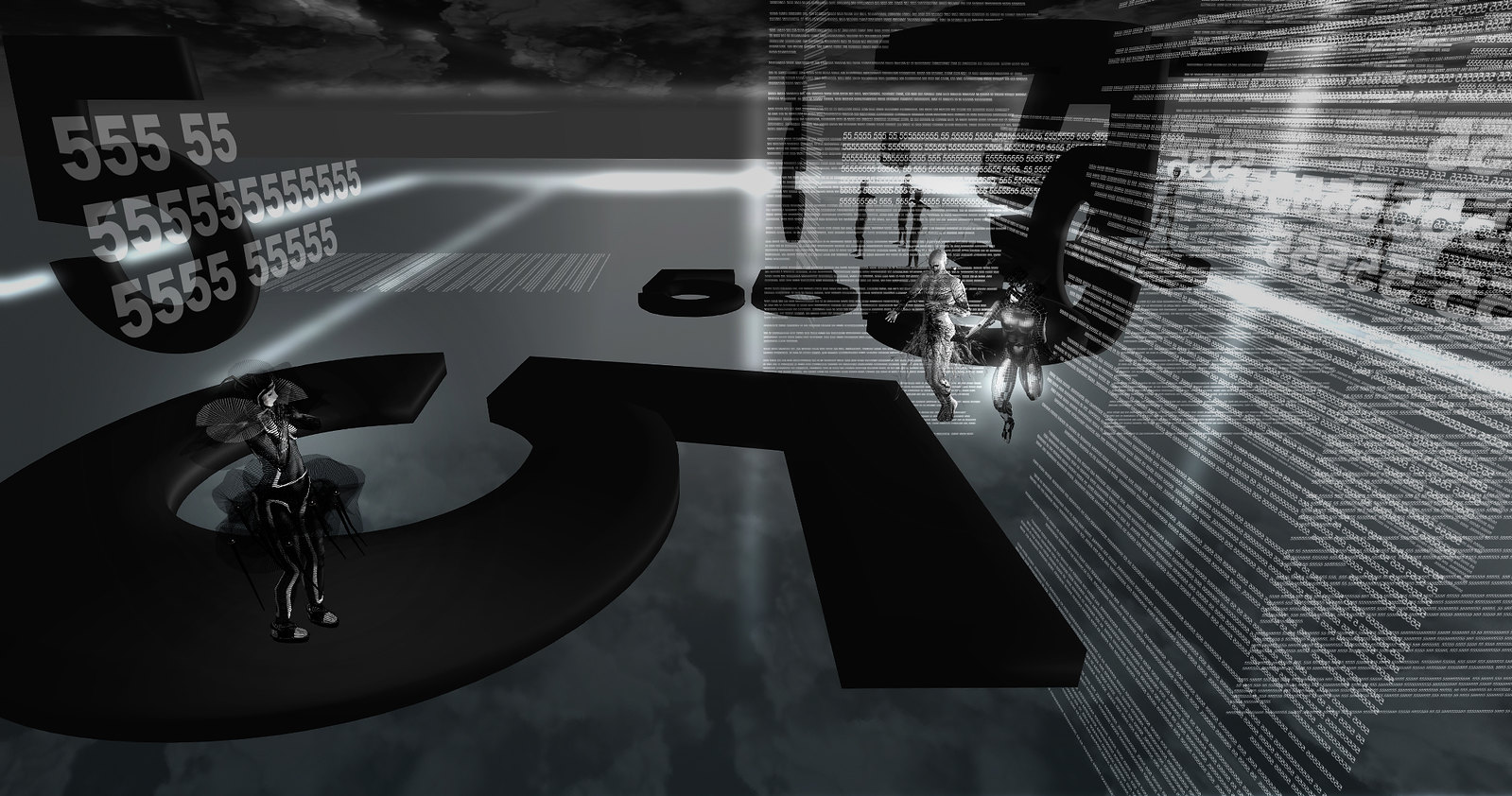
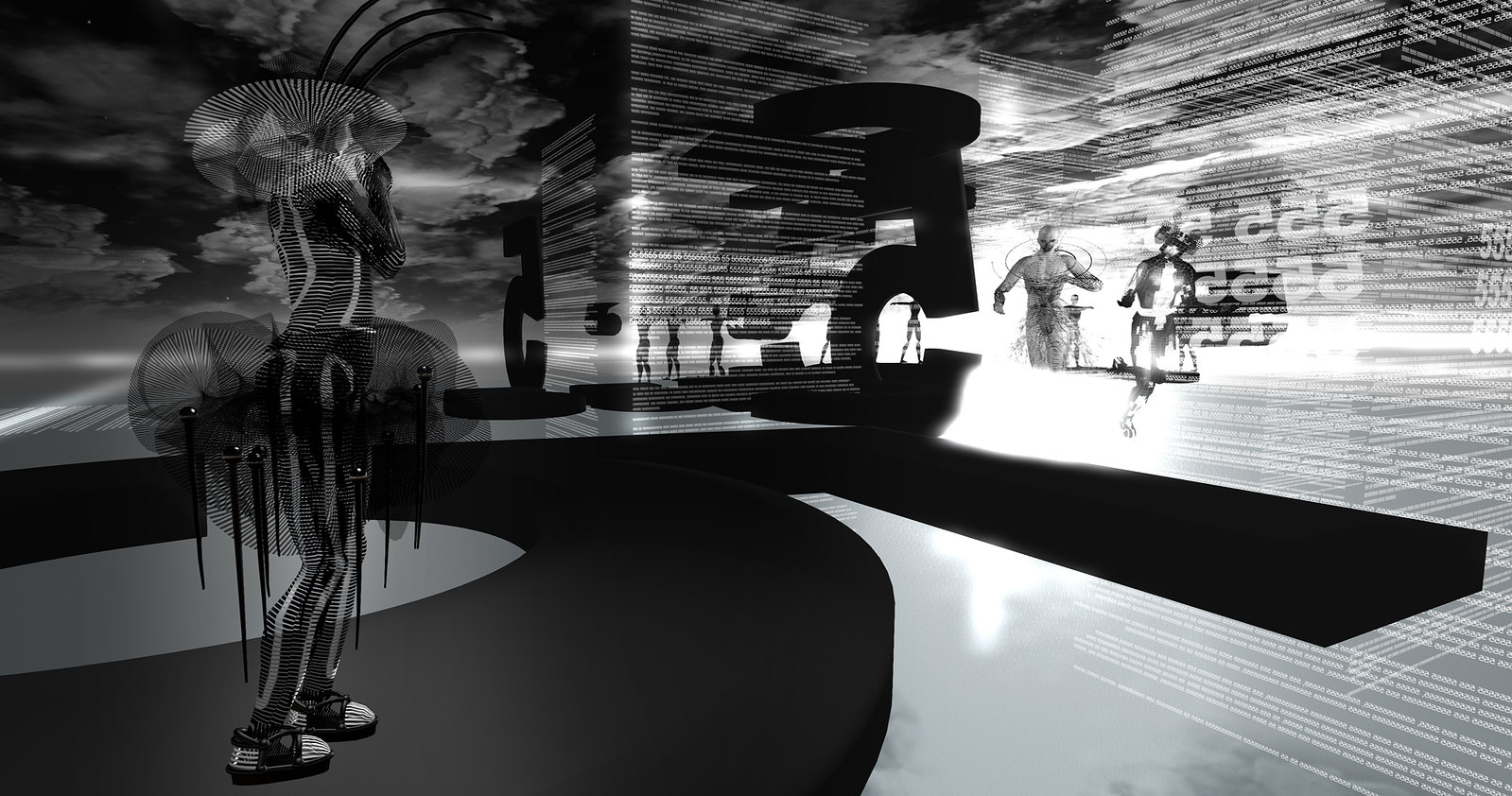
I wanted my letters in space always to face the primary tracked point of view. If the tracked reader is positioned at the edge of a plane of letters and she turns to face the plane edge-on, the letters turn to face her. Their images overlap, occlude one another — partially or wholly — and recede in view since the majority of them will be successively more or less distant. ‘Normally’ the surfaces of the larger closer letters would cover the more distant smaller letters. However, because of the ‘bug,’ smaller letter outlines are clearly discernible within but ‘over’ the forms of the nearer letters.

Given these circumstances, and because, I believe, all the letter forms are familiar — both visually and symbolically legible — and because we know what their relative scale ‘should be,’ this produces a striking and somewhat bizarre visual illusion.

We assume that even though the smaller letters are rendered ‘over’ the larger ones, they must be more distant. Thus, what we see is a very deep and narrow corridor formed from letter shapes, with the most distant smallest letters visible in completely edged outline, apparently farthest off, as if inscribed on a tall, thin distant end ‘wall’ of the corridor. Moreover, the reader is able to move ‘into’ the corridor formed by this plane of letter shapes.

This powerful perceptual experience is demonstrable and repeatable, despite its artificiality and strangeness. The question arises, why should this phenomenon be so immediate and effective? As we asked above, why doesn’t the linguistic materiality of the graphic forms and structures run counter to their visuality, counter to whatever illusion of space may or may not be generated? At this point I began to formulate a hypothesis: literal forms are highly effective for delineating space in immersive virtual environments.

I believe that there are a number of quite common sense related reasons for this. Letter forms are relatively complex and the differences instantiated in this complexity are necessarily and systematically significant. Letter forms are both complex and arbitrary but they are also familiar and rational seeming. They are instantly recognizable and encountered with remarkable, perhaps unique, frequency by any subject in a culture where the set of script forms in question is current, particularly, of course, by subjects who use these forms to read and write.

Moreover we have a very well entrenched set of expectations in relation to the relative size of these arbitrary graphic shapes. If we believe them to be on the same plane, we expect literal elements all to be of a similar or commensurate size (equal constituents of the same text) or, if they are of different sizes, we expect there to be a paratextual reason for this (because, for example, the letters are part of an emphasized word or a title). If we see words or letters which are larger than the letters surrounding them and there is no paratextual reason for this, we are likely to think that these letters are closer to us than any surrounding smaller letters.

____

If these effects are conceded, it follows that literal materiality can have powerful influence on the shaping of immersive 3-D space and the structures within it. What I take to be happening is that the pre-existing, enculturated phenomenology of textuality, when disposed in this illusory space, struggles to maintain its real-world phenomenology, with and against the graphic world’s programmed structures. A relationship of mutual interference and influence develops in which the phenomenology of text shapes the reader’s experience of space while, at the same time, of course, spatiality works to alter our phenomenological experience of text in its new, artificial environment.

____

The following posts are quotes that have been harvested from Anna Katharina Schaffner's 2010 book chapter From Concrete to Digital: The Reconceptualization of Poetic Space.
  1. APA: Schaffner, A. K. (2010). From Concrete to Digital: The Reconceptualization of Poetic Space, in Beyond the Screen: Transformations of Literary Structures, Interfaces and Genres, Schaefer, J., Gendolla, P. (eds), Transcript-Verlag, Bielefeld, Germany, p: 179 - 199.
  2. Chicago: Anna Katharina Schaffner, From Concrete to Digital: The Reconceptualization of Poetic Space, in Beyond the Screen: Transformations of Literary Structures, Interfaces and Genres, Schaefer, J., Gendolla, P. (eds), Transcript-Verlag, Bielefeld, Germany, (2010): 179 - 199.

____


____

Digital poetry is frequently, and I believe correctly, assigned to the wider trajectory of experimental/avant-garde poetry in many other studies as well. It is often considered as a third stage, contemporary continuation and further development of earlier experiments.

How did concrete poetry redefine poetic space and how are space and its parameters reconfigured once more in digital poetry in a second step? And what happens to the notion of ‘concrete’ in the web?

____

Digital works are similar to concrete poetry on the following levels: they are works that operate conceptually with space, they explore the “verbivocovisual” qualities of the letter material, mostly work with few concentrated words or letters, focusing on reduced, minimalist and structural relationships between the linguistic elements, suppressing or reducing syntactic links in favor of an exploration of multiple dynamic structures.

A concern with space and the parameters of surface is arguably one of the major poetic features of concrete poetry. Values such as positions of the signifier material, relationships between the linguistic elements and their spatial interaction, and distance, density and exact arrangement of the letter material gain structural and semantic significance.

The German concrete poet Franz Mon advocates the creative exploitation of the spatial values of the page by saying that in concrete poetry, the functions of surface replace the functions of grammar and open up new possibilities, both for poetry and thought. The relationships between spatially arranged words are not fixed and unambiguously predetermined like the relations of words firmly arranged in syntactical hierarchies, but are open and flexible and subject to continual redefinition during the process of reception. The position of the textual elements on the page, the distance between them and the density of the textual field all acquire potential semantic significance, and serve as extensions of the conventional means of structuring a poem. They become an integral part of the semiotic set up, and introduce additional particles and tools of expression. The conceptual deployment of surface values thus constitutes a novel way of charging language with meaning, and allows for the expression of what cannot be expressed within the boundaries of existing grammatical frameworks.

____

The signs on screen have an additional technical dimension attached to them. One of the major concerns of avant-garde and concrete poetry alike is the exploration of the medium of usage, the language material, its physically perceptible qualities, its visual and acoustic dimension.
In extreme cases, signs are deprived entirely of their representative function and pragmatic use value, referring to themselves and their concrete materiality alone.

In digital poetry too, attention is frequently directed to the material and the medium and its conventions – one of the reasons why many consider it a continuation of the avant-garde tradition in the first place. However, on the screen, the material is no longer just language, but language with a whole new cosmos of technical meaning attached to it. As Florian Cramer has pointed out, language in its specific manifestation in the computer is marked by a paradoxical double function as both message and code: language is not only transmitted as message on the screen, but also controls and generates this transmission behind the screen in the form of codes and programming languages. Self-reflexive digital texts frequently include or reference the processes by which they were generated, they reflect upon the technologies that have produced them.

____

Language is frequently presented visually on the monitor, as image. Katherine Hayles has coined the influential notion of the “flickering signifier” in her study "How we became Posthuman." Text is treated graphically on screen, she argues, and morphs into a flickering image, an instable visual display, and it is no longer a material object.

Beiguelman too emphasises the imagetic condition of the screen text, and at the same time the essentially textual condition of the web: on the screen, images perform texts, and behind the screen, texts generate these images. This thesis is explored both visually and textually in her work “the book after the book” (1997), where the idea of the flickering signifiers, of the dissolution of the boundaries between text and image and the graphic treatment of text on the screen are explored. The internet, Beiguelman writes, “is no more than a big text. On the front, at the screen, text reveals itself as image.”

____


____

The screen is redefined by the addition of two further dimensions which the page lacks: a temporal one, and the third dimension, the simulation of depth. New spatio-temporal parameters thus become possible.

On the screen, space is no longer flat, but multiple layers of textual organization become possible. The dimension of depth is added, foreground and background relations can be constructed, letters can be superimposed upon others, distance and proximity can be simulated. Writing becomes volumetric: letters can suddenly be viewed from all sides, from behind, below, above, they can be rotated and turned around their own axis like real objects in space.

____

Digital poetry actually emerged from the orbit of concrete poetry in the late 1950s in Stuttgart. In fact, the deployment of computers for the artificial generation of poetry was nothing but the logical consequence of the theoretical reflections of an important figure of the concrete poetry movement. One could even say that it was the product of certain aspects of concrete poetry driven to their utmost extremes – which closes the circle rather nicely.

The German scholar, philosopher and poet Max Bense was one of the leading figures of the concrete poets of the Stuttgarter Gruppe, and an important international mediator between various different national groups and factions. He was preoccupied with the study of philosophy, mathematics, technology and theory of science as well as with information theory, semiotics and cybernetics. Bense is certainly the most radical pursuer of objectivity and scientific exactitude, but Eugen Gomringer too emphasised the importance of method, system and structure, and experiments with stochastic, permutational and combinatorial structures can also be observed in many other concrete oeuvres, such as Franz Mon’s and those of the Wiener Gruppe.

In his Einführung in die informationstheoretische Ästhetik. Grundlegung und Anwendung in der Texttheorie from 1969, Bense describes “aesthetic states” of texts as defined by their degree of unexpected, surprising and non-trivial occurrence of words. This notion is a direct transfer of Claude E. Shannon’s definition of information as “unexpected, unpredictable news” into the realms of the aesthetic.

To my knowledge, Bense and his students were the very first ever to deploy computers for purely aesthetic purposes in order to produce stochastic, machine-generated poetry. They deployed the random function of computers for the generation of “unlikely, highly selective and non-trivial” sequences – which is Bense’s defintion of what makes a text aesthetic rather than functional. In 1959, in the computer lab of the ‘Technische Hochschule’, Theo Lutz fed vocabulary taken from Franz Kafka’s Das Schloss into a Zuse Z 22, and wrote a program determining several rules of combination, and thus generated the first artificial, chance determined literary text.