

____
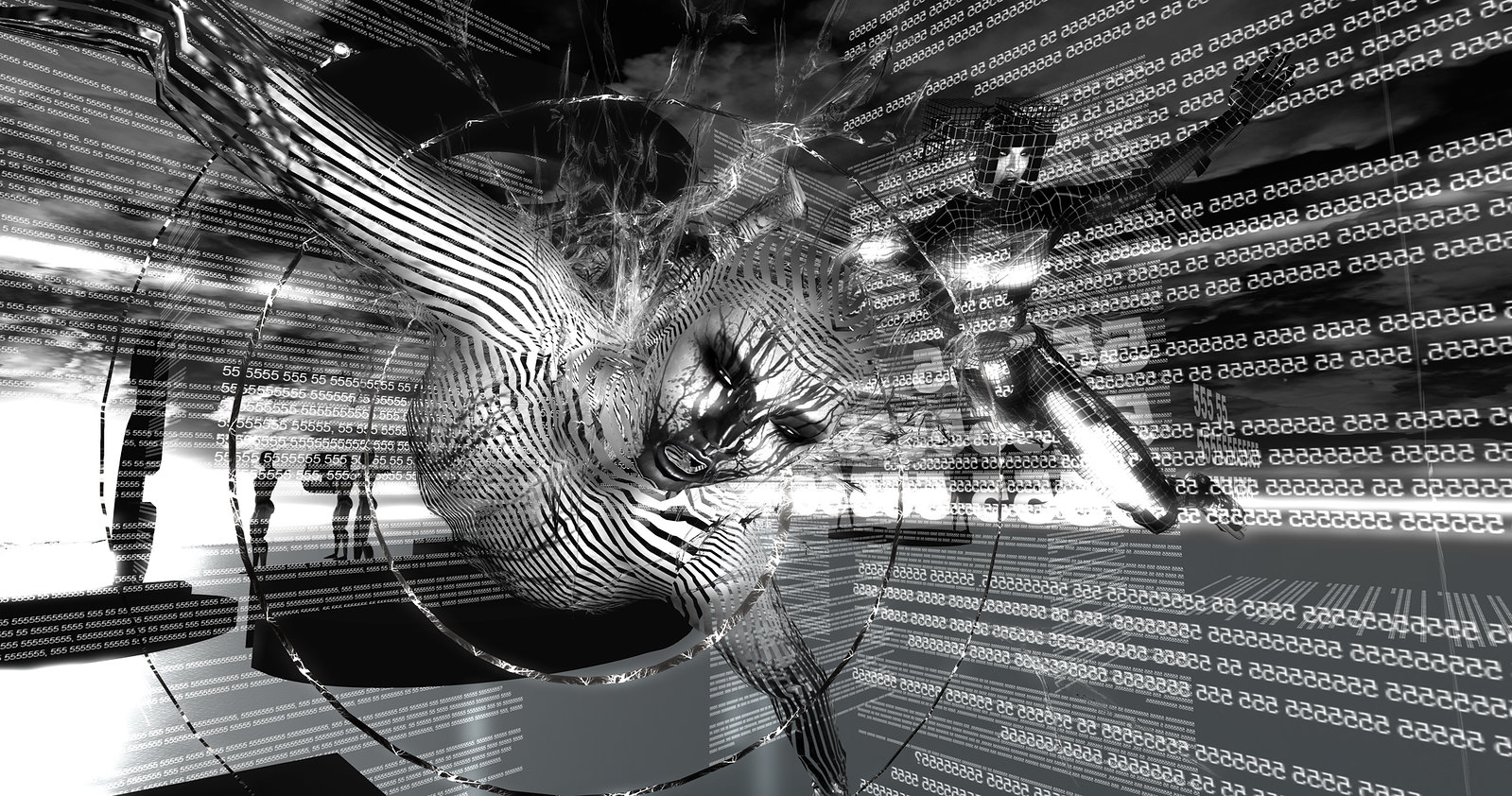
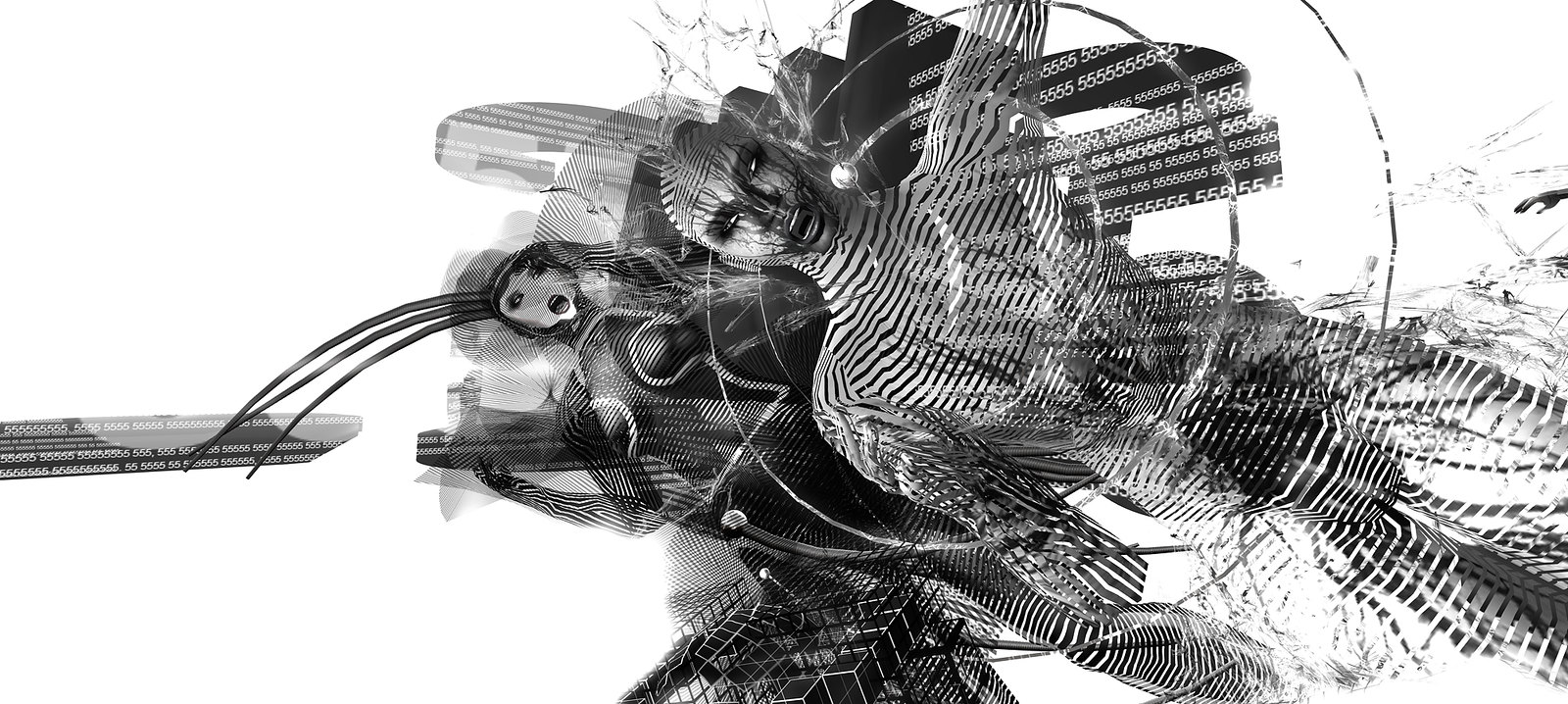
5555555 55555 555 came about when artist avatar Giovanna Cerise invited me to contribute to her collaborative SL project revolving around numbers. The idea was that I had to pick a number between 0 and 9 and everything that I built had to be made out of that single digit. Given my preoccupation with typography in 3D I gave a most enthusiastic "yes" as a response to her invite and built a space made only out of 5s. I am a graphic designer whose specialization is layout. That is the thing that I am good at (or at least, so I hope). So, the space that I built might be called a magazine spread of sorts, with body text, subheadings and headlines. I wondered if text composed of a single glyph would still give a sense of "content" when placed in such a way, in a logic that followed the typographic hierarchies of a standard page layout.
However, the project took on a life of its own after I completed the building. I started to think about how avatars would behave if they could only talk in 5s. What sort of a world would that be?
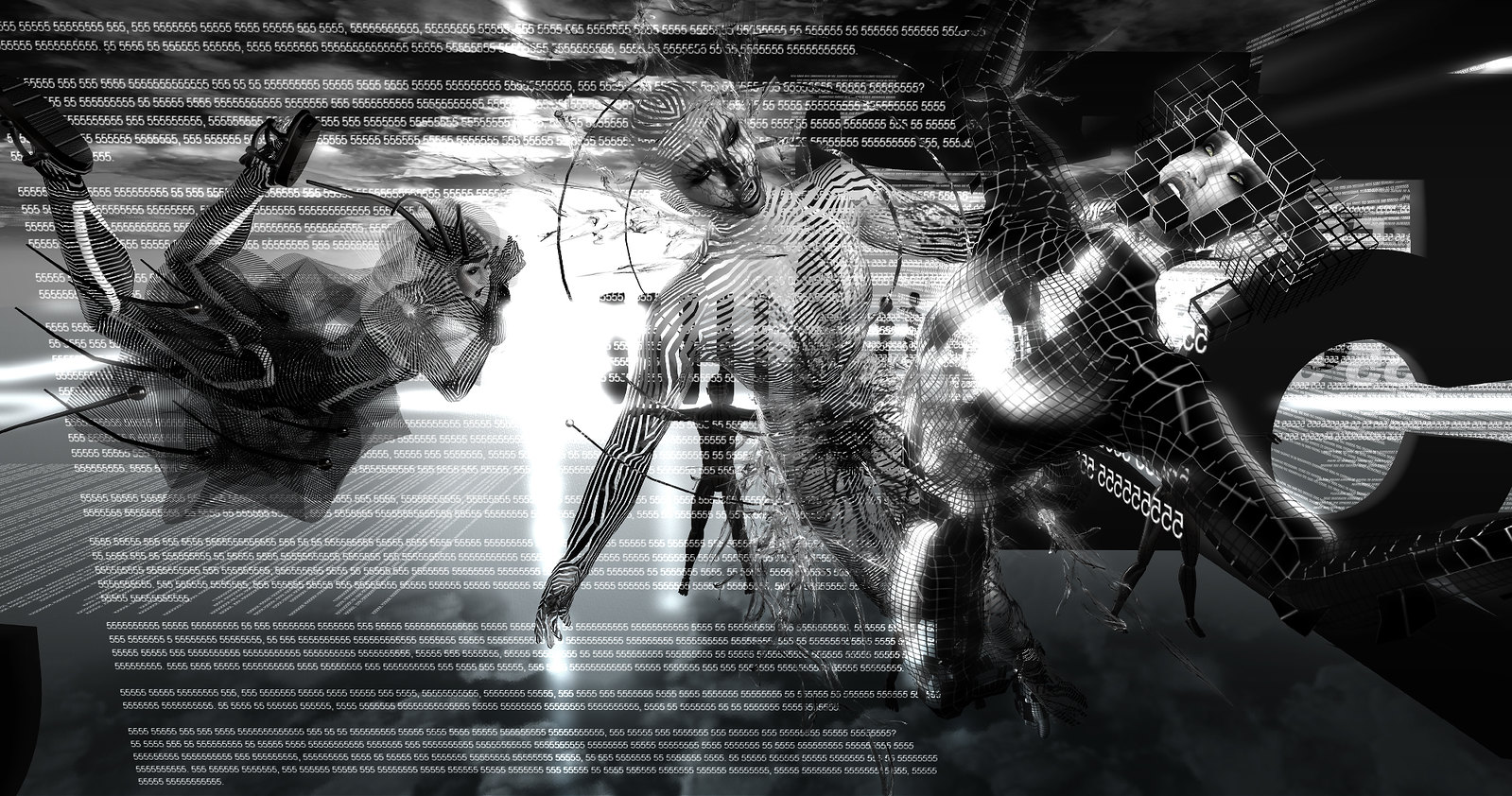
The tale is very simple: A lonesome avatar appropriates a strange world where one can only talk in 5s. But then she gets company - which, at first, she rejects since she does not want to share what she holds to be solely her own. But then she is talked into playing with the incomers.
Has a good time. However, just at the height of the fun and games "they" turn around and go. Leaving her bereft.
I took many photographs of this storyline. Then, I added speech bubbles (made out of strings of 5 to resemble words) to these images. Finally,
I deconstructed these little textual snippets in such a way that they would express some sort of "emotion" - to make up for the circumstance that conveying actual "meaning" is beyond their meager capabilities.
Out of these typographically enhanced screenshots I have made several displays of the tale. In fact, part of the experiment is too see how I can tell the same "tale" through different means: A storyboard type thing made with a tumblr infinite grid (click on image above this post), a flipbook and a prezi (both of which can be accessed below this post). And I intend to do a stop-motion video as well. At first I did not want to place any explanatory text in these, just let the viewer build the tale - or not. However, then I felt that this was probably way too stark; and erring on the side of caution, I added a few clues here and there.
Another thing that came out of all this is a literature review that I intend to put to good use in not only one, but several papers which I plan to write about all this. 5555555 55555 555 led me to terms such as "constrained writing" and "concrete poetry," as well as taking me back to previously examined concepts such as aleatoric and asemic writing. This review is mostly for my own benefit - but, who knows, it may interest others also. Therefore, some of what I read on these subjects has been extracted and can be found in the links on the right. And more links to papers that I have not yet extracted the relevant passages from can be found in a list at the bottom of this page.
However, the project took on a life of its own after I completed the building. I started to think about how avatars would behave if they could only talk in 5s. What sort of a world would that be?
The tale is very simple: A lonesome avatar appropriates a strange world where one can only talk in 5s. But then she gets company - which, at first, she rejects since she does not want to share what she holds to be solely her own. But then she is talked into playing with the incomers.
Has a good time. However, just at the height of the fun and games "they" turn around and go. Leaving her bereft.
I took many photographs of this storyline. Then, I added speech bubbles (made out of strings of 5 to resemble words) to these images. Finally,
I deconstructed these little textual snippets in such a way that they would express some sort of "emotion" - to make up for the circumstance that conveying actual "meaning" is beyond their meager capabilities.
Out of these typographically enhanced screenshots I have made several displays of the tale. In fact, part of the experiment is too see how I can tell the same "tale" through different means: A storyboard type thing made with a tumblr infinite grid (click on image above this post), a flipbook and a prezi (both of which can be accessed below this post). And I intend to do a stop-motion video as well. At first I did not want to place any explanatory text in these, just let the viewer build the tale - or not. However, then I felt that this was probably way too stark; and erring on the side of caution, I added a few clues here and there.
Another thing that came out of all this is a literature review that I intend to put to good use in not only one, but several papers which I plan to write about all this. 5555555 55555 555 led me to terms such as "constrained writing" and "concrete poetry," as well as taking me back to previously examined concepts such as aleatoric and asemic writing. This review is mostly for my own benefit - but, who knows, it may interest others also. Therefore, some of what I read on these subjects has been extracted and can be found in the links on the right. And more links to papers that I have not yet extracted the relevant passages from can be found in a list at the bottom of this page.

____
The 'constrained' encounter followed through a zoomable interface can be seen by clicking on the image below:

____
I wrote a paper for the IS&T/SPIE Electronic Imaging 2014 conference which I will be presenting on February 3rd in San Francisco. The paper (which can be downloaded from here >>>) combines a literature review of the behavior of text in three dimensional virtual spaces with concrete/digital poetry and constrained writing; followed by an exposition of 5555555 55555 555 in relationship to these topics.
I also made a prezi with which I intend to present the paper at the conference, and this can be viewed by clicking on the image below.

I also made a prezi with which I intend to present the paper at the conference, and this can be viewed by clicking on the image below.
____
Links for Aleatoric poetry, Concrete poetry, Asemic Writing, Constrained Writing, etc...
Writing as Re-Writing: Concrete Poetry as Arrière-Garde by Marjorie Perloff
Augusto de Campos, Digital Poetry, and the Anthropophagic Imperative by Chris Funkhouser
Poetic Transformations in(to) the Digital, Friedrich W. Block and Rui Torres
Ut Pictura Hyperpoesis: Spatial Form, Visuality, and the Digital Word, John Tolva
Digital poetics or On the evolution of experimental media poetry, Friedrich W. Block
The Code is not the Text (unless it is the Text), John Cayley
Writing on Complex Surfaces, John Cayley
O V E R B O A R D: An Example of Ambient Time-Based Poetics in digital art, John Cayley
Search results for "Marinetti Typography" in Futurist Typography and the Liberated Text, by Alan Bartram
"Aleatoric poetry" search results in Claims for Poetry, edited by Donald Hall
Conceptual Poetics: Christian Bök, by Kenneth Goldsmith
Dichtung Digital
Oulipo
Constrained Writing
Futurism portal
Links for 3D, Typography, Deconstruction, etc...
Navigating large bodies of text by David Small
Typography Use in Hypertext Documents: Why Designers Make Font Choices by Andrew Williams
The Exploration of Static Typography for Expressing The Emotive Qualities of Music. PhD dissertation by Amanda Lu
From Movable Type to Moving Type-Evolution in technological mediated Typography by Gerhard Bachfischer and Toni Robertson
Deconstruction and graphic design: history meets theory by Ellen Lupton and J. Abbott Miller
A rhetoric of e| mediated (typo) graphicacy by Alan Robertson
The Status and the Prospects of Deconstruction in Graphic Design by Dong-Sik Hong, and Mijeong Hwang
A Study on the Deconstructionist Representation in Graphic Design by Dong-Sik Hong
Fluid Typography: Construction, Metamorphosis and Revelation by Barbara Brownie
Between Text and Image, East and West: Henri Michaux’s Signs and Christian Dotremont’s «Logogrammes» by Nina Parish
Visual arts and 2D–3D motion typo. graphic design by Anastasios Maragiannis
The poetics of transition: the ambiguous characteristics of virtual typography by Matthias Hillner
Writing as Re-Writing: Concrete Poetry as Arrière-Garde by Marjorie Perloff
Augusto de Campos, Digital Poetry, and the Anthropophagic Imperative by Chris Funkhouser
Poetic Transformations in(to) the Digital, Friedrich W. Block and Rui Torres
Ut Pictura Hyperpoesis: Spatial Form, Visuality, and the Digital Word, John Tolva
Digital poetics or On the evolution of experimental media poetry, Friedrich W. Block
The Code is not the Text (unless it is the Text), John Cayley
Writing on Complex Surfaces, John Cayley
O V E R B O A R D: An Example of Ambient Time-Based Poetics in digital art, John Cayley
Search results for "Marinetti Typography" in Futurist Typography and the Liberated Text, by Alan Bartram
"Aleatoric poetry" search results in Claims for Poetry, edited by Donald Hall
Conceptual Poetics: Christian Bök, by Kenneth Goldsmith
Dichtung Digital
Oulipo
Constrained Writing
Futurism portal
Links for 3D, Typography, Deconstruction, etc...
Navigating large bodies of text by David Small
Typography Use in Hypertext Documents: Why Designers Make Font Choices by Andrew Williams
The Exploration of Static Typography for Expressing The Emotive Qualities of Music. PhD dissertation by Amanda Lu
From Movable Type to Moving Type-Evolution in technological mediated Typography by Gerhard Bachfischer and Toni Robertson
Deconstruction and graphic design: history meets theory by Ellen Lupton and J. Abbott Miller
A rhetoric of e| mediated (typo) graphicacy by Alan Robertson
The Status and the Prospects of Deconstruction in Graphic Design by Dong-Sik Hong, and Mijeong Hwang
A Study on the Deconstructionist Representation in Graphic Design by Dong-Sik Hong
Fluid Typography: Construction, Metamorphosis and Revelation by Barbara Brownie
Between Text and Image, East and West: Henri Michaux’s Signs and Christian Dotremont’s «Logogrammes» by Nina Parish
Visual arts and 2D–3D motion typo. graphic design by Anastasios Maragiannis
The poetics of transition: the ambiguous characteristics of virtual typography by Matthias Hillner
____
The following posts have been extracted from Rebecca Sharp, Peter McKinney and Seamus Ross's 2003 article Visual Text: concrete poetry, hyperfiction and the future of the narrative form.
- APA: Sharp, R., McKinney, P., & Ross, S. (2007). Visual text: Concrete poetry, hyperfiction and the future of the narrative form. Glasgow: Humanities Advanced Technology and Information Institute (HATII), at http://www.ed.ac.uk/iash/vkpublication/Sharp_McKinney_Ross. pdf, accessed, 31 12 2013
- Chicago: Sharp, Rebecca, Peter McKinney, and Seamus Ross. "Visual text: Concrete poetry, hyperfiction and the future of the narrative form." Glasgow: Humanities Advanced Technology and Information Institute (HATII), at http://www.ed. ac.uk/iash/vkpublication/Sharp_McKinney_Ross. pdf, (2007), accessed, 31 12 2013.
____
In 1953, the Swiss poet Eugen Gomringer published a collection of his works, each only one word in length. He referred to them as constellations and insisted that it was the positioning of the word on the page that was of more importance than the meaning of the word itself. In that same year, in Sweden, Oyvind Fahlstrom wrote a Concrete Poetry Manifesto, however he apparently had no knowledge of Gomringer’s work. Simultaneously and similarly oblivious to the new style emerging in Europe, a group of Brazilian poets, the Noigrandres, were experimenting with poetry as a visual medium, using the object form of the ideogram and would later name this style Poesia Concreta. It was a time of great co-incidence, given the contemporaneous experiments with structure and form in the fields of music and painting, and the recurring use of the word ‘concrete’.
More than that, however, it signalled a global desire to progress beyond traditional linear representation and start manipulating the very substances out of which art is made.
More than that, however, it signalled a global desire to progress beyond traditional linear representation and start manipulating the very substances out of which art is made.
____
The concept at the heart of it all, the word as visual image, was far from new. In the early 20th century, Guillaume Apollinaire constructed complex visual collages from letters, words and phrases in Calligrammes, exploring spatial relationships and offering multiple non-linear readings of the text. Similarly at that time, the Futurists, Dadaists and Cubists emphasized semiotics and materiality. Earlier still, the optical poems of the Baroque period made visual forms, such as a labyrinth, from lines of text. An example from 1637 presents an early form of interactive writing. A wedding poem, whose lines take the form of a drinking goblet requires the reader to turn either the paper or their head around in order to follow the text, the resultant dizzy feeling recalling the sensation of having drunk a goblet of wine.
In concrete poetry, however, rather than the visual element being illustrative or incidental, the physicality of language instructs and indeed constitutes the structural form. Poets would actively communicate the space between words and letters, manipulate typography, and introduce design elements borrowed from popular culture.
In concrete poetry, however, rather than the visual element being illustrative or incidental, the physicality of language instructs and indeed constitutes the structural form. Poets would actively communicate the space between words and letters, manipulate typography, and introduce design elements borrowed from popular culture.
____
Concrete poetry by necessity involves a reduction of language. Emotions and ideas are not the physical materials here and so it is the language itself that is dismantled in terms of form, design and function. Significant also was the new relation to space; no longer an impermeable yet impotent backdrop against which text must rigidly stand, the new writing broke out and into the areas all around the text, allowing the eye to form patterns of its own and the mind to make new, independent inferences. In so undermining the security between word and page, concrete poetry also dislocated word from meaning and furthermore, destabilised the traditional relationship between the text and the reader.
This then heralds one of the most significant features of the style: In order for meaning to be communicated, the reader must actively engage in the text; deciphering its layout and typography, interpreting its shapes and spaces, viewing the work as an object and thereby playing an active role in its creation.
The discoveries made by this genre were at once progressive and contingent on past experiments, with several sub-genres such as kinetic, spatialist, instamatic and code poetry emerging from within. To trace these developments toward the present day is one road into the crux of the issues surrounding current endeavours in digital technology.
This then heralds one of the most significant features of the style: In order for meaning to be communicated, the reader must actively engage in the text; deciphering its layout and typography, interpreting its shapes and spaces, viewing the work as an object and thereby playing an active role in its creation.
The discoveries made by this genre were at once progressive and contingent on past experiments, with several sub-genres such as kinetic, spatialist, instamatic and code poetry emerging from within. To trace these developments toward the present day is one road into the crux of the issues surrounding current endeavours in digital technology.
____
Emmett Williams wrote of concrete poetry, '...It was born of the times, as a way of knowing and saying something about the world now, with the techniques and insights of now.’ (Emmett 1967, vi) The same is true of narratives in the digital realm. However, not content with mere manipulation of the linguistic and graphic qualities of words, in digital media time itself becomes a malleable object, with animation and interaction as actual rather than implied properties. Reader interaction too becomes a more literal aspect of works in new media; it would seem that the Barthesian ‘writerly reader’ has found a new home.
____
Advances in new technology and the trend towards non-linearity in various narrative forms have occurred in tandem during postmodern times. The departure from linearity was not the revolution it might have seemed, however, with each new technological development, writers have been able to expand their perspectives and delve deeper into the issues at play. Thus, the multiform story with its multiple plotlines and intertextual connections can be seen to reflect the fragmentation of personal identity in postmodern culture.
____
Semiotics and deconstructionist theory have taught us that all beings and objects constitute and are constituted of signs within a vast network of signs, each reliant on the others to gain inferred validation, devoid of meaning beyond this complex construct. What right then does any person have to claim authorship of a text, when its creation is by implication contingent on so much more than just one person’s imagination?
____
The following posts have been extracted from Brian Lennon's 2000 article Screening a Digital Visual Poetics.
- APA: Lennon, B. (2000). Screening a digital visual poetics. Configurations, 8(1), 63-85.
- Chicago: Brian Lennon. "Screening a digital visual poetics." Configurations 8, no. 1 (2000): 63-85.
____
Recent trends in digital media theory signal the absorption of initial, utopian claims made for electronic hypertextuality and for the transformation of both quotidian and literary discourse via the radical enfranchisement of active readers. Born in 1993, the democratizing, decentralizing World Wide Web - at first, the “almost embarrassingly literal embodiment” (Landow 1992, 34) of post-structuralist literary theory, a global Storyspace, has been appropriated, consolidated, and “videated” as a forum for commerce and advertising. Thinkers such as Landow, Bolter and Grusin have seen from the start that electronic hypertextuality, or the computerized proliferation of symbolic writing, was only a step on the way to general electronic hypermediation dominated by iconic visual, rather than symbolic textual, forms.
As if in response to this, web-based or distributed electronic writing has evolved from its first alphabetic-(hyper)textual forms toward diverse incorporations of, and hybridizations with, the static or kinetic image. Poets and visual artists working from a tradition of typographic experimentation that reaches back to futurism and Dada, and includes twentieth-century visual and Concrete poetry, are using networked, heterogenetic writing spaces to create and distribute a new electronic visual poetry. This growth of visual writing may be seen as a response to the technological acceleration that permits more and more complex forms of information - from simple text, to static images, to animated and then to user-interactive text-image clusters or constellations, what might be called “lex/icons” - to coexist in one “medium” or information-delivery system. As Bolter suggests, “True electronic writing is not limited to verbal text: the writeable elements may be words, images, sounds, or even actions that the computer is directed to perform.” (Bolter 1991, 26)
As if in response to this, web-based or distributed electronic writing has evolved from its first alphabetic-(hyper)textual forms toward diverse incorporations of, and hybridizations with, the static or kinetic image. Poets and visual artists working from a tradition of typographic experimentation that reaches back to futurism and Dada, and includes twentieth-century visual and Concrete poetry, are using networked, heterogenetic writing spaces to create and distribute a new electronic visual poetry. This growth of visual writing may be seen as a response to the technological acceleration that permits more and more complex forms of information - from simple text, to static images, to animated and then to user-interactive text-image clusters or constellations, what might be called “lex/icons” - to coexist in one “medium” or information-delivery system. As Bolter suggests, “True electronic writing is not limited to verbal text: the writeable elements may be words, images, sounds, or even actions that the computer is directed to perform.” (Bolter 1991, 26)
____
Out of habit, we identify the “modernist” poetic text as “materialized,” and the “postmodernist” poetic text as “dematerialized,” ephemeral, a “simulacrum.” The extent, however, to which “materiality” (taken as sensous, extraverbal reality, something more than the functional-instrumental, “transparent” use-value of a word) is integral to much postmodernist poetry, poetics, and art practice might be seen as reason to interrogate this habit of thought.


